
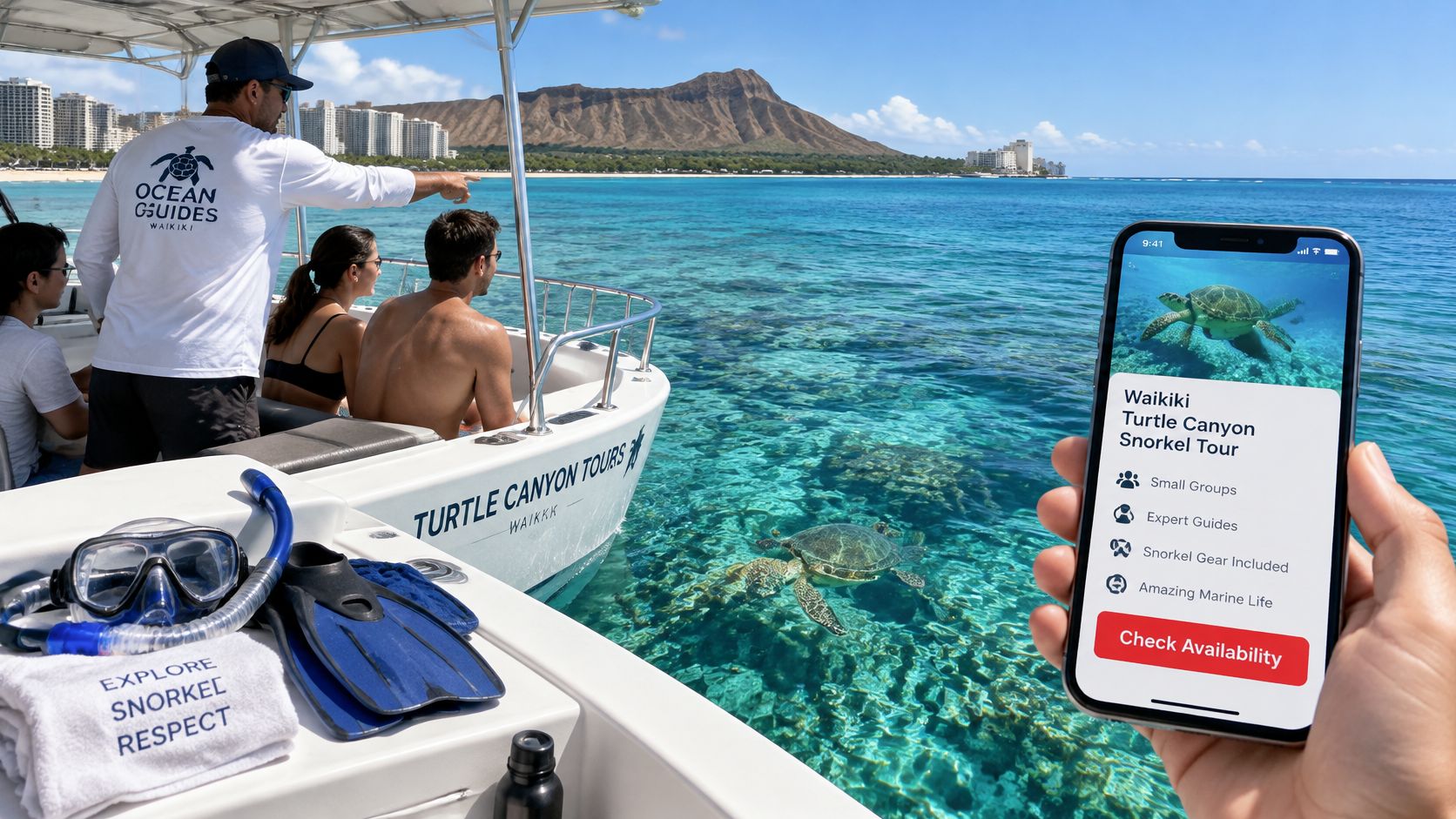
A Waikiki Turtle Canyon snorkel is a two-hour guided boat trip from Pier B with about 60 minutes of supervised snorkeling, with a mask, snorkel, fins and flotation vest provided on board. The important booking decision is whether everyone in your group feels comfortable entering open water, not whether they already own snorkeling gear.
You might be comparing departures on your phone while a child asks how close the turtles will come and another adult wonders whether the vest means swimming skills don't matter. Those are useful questions. A well-run trip gives you time to settle into your equipment, clear instructions about where to float, and a way to speak up before nerves become a problem.
Table of Contents
- Why Turtle Canyon Needs a Guided Boat Trip
- How the Two-Hour Trip Unfolds From Pier B
- What Is Included and What to Bring Yourself
- Time in the Water and Turtle Distance Rules
- Is It Right for Beginners and Families
- Check Availability and Book Your Turtle Canyon Snorkel
Why Turtle Canyon Needs a Guided Boat Trip
From the sand at Waikiki, Turtle Canyon can look close enough to swim. The reef sits just off Oahu's south shore, yet it is offshore and cannot be reached safely from the beach.
Shore snorkeling keeps your exit close, but crowded, wave-swept water can make turtles harder to find. Turtle Canyon offers deeper water, better visibility and a higher likelihood of sightings; the trade-off is open water under crew direction.
A protected animal, not an attraction to handle
Hawaiian green sea turtles, or honu, belong to the genetically distinct Central North Pacific population and remain federally listed as threatened and protected by Hawaiʻi state law; the Hawaiʻi Division of Aquatic Resources records state protection in 1974 and federal listing in 1978 after severe overharvesting from the 1950s through the early 1970s.
Recovery has not removed their vulnerability. NOAA's 2024 Pacific protected-species research describes Hawaiian green turtles nesting mainly on sandy islets at remote Pacific atolls, leaving their breeding geography concentrated.
A guide does more than drive the boat. The crew explains the boundaries before entry: do not touch or chase turtles, and stay at least 10 feet away even when one swims within a few feet of you. Briefing, gear fitting, staggered entry and crew positioning keep a mixed group spaced and manageable around the animals.
Flotation support and swimming readiness are different things. A vest helps you float and in-water support helps beginners, yet you still need enough comfort to breathe through a snorkel, keep your face down and speak up early if nerves build.
Snorkel Turtle Canyon sees sea turtles on 99% of its trips, but wild animals set the schedule. What the tour controls is access, supervision and spacing, which shapes the encounter for a family or a first-timer.
How the Two-Hour Trip Unfolds From Pier B
The excursion lasts about two hours, including roughly 60 minutes of supervised snorkeling. The remaining time accommodates boarding, coastal cruising, preparation and the return to the dock, rather than an uninterrupted swim.
Our departure point is Pier B, 1025 Ala Moana Blvd, Honolulu, HI 96814, convenient for guests staying at Waikiki hotels and resorts. Allow for your actual transfer route rather than assuming that a Waikiki-area departure means you can walk from every hotel.
Two-hour Turtle Canyon trip at a glance
| Stage | Approximate timing | What happens |
|---|---|---|
| Check-in at Pier B | Before departure, at the check-in time on your confirmation | Confirm your booking and find the boat |
| Boarding and scenic cruise | Opening portion of the excursion | Coastal views of the Waikiki skyline and south shore |
| Safety briefing and gear fitting | Before water entry | Crew explains turtle rules and fits masks, fins and vests |
| Supervised snorkeling | About 60 minutes | Crew points out turtles, reef fish and habitat features |
| Return cruise and disembark | Closing portion of the excursion | Return gear and head back to Pier B |
| Total trip | About 2 hours | Guided boat tour with in-water time at the reef |
After check-in, you board a spacious, comfortable boat for the cruise along the coast. Keep your bag contained and listen for crew directions rather than spreading equipment across shared seating.
The cruise is also preparation time. Tell the crew about limited swimming ability, anxiety or a mask that doesn't feel right before you're standing at the entry point.
Dockside recommendation: Use the departure and check-in details on your booking confirmation. Don't substitute a schedule from an old review or another operator's listing.
Before entry, the crew provides the safety briefing and marine-life orientation. Listen for the group's observation area, entry instructions and the signal to use if you need assistance.
The return cruise gives you time to dry off and collect your belongings before disembarking at Pier B. Exact clock times are confirmed at booking, so confirm your departure and reserve your place before planning the rest of your day around it.
What Is Included and What to Bring Yourself
A mask, snorkel, fins and flotation vest are provided for every guest, so you don't need to arrange separate equipment rental. Bring a swimsuit, towel, reef-safe sunscreen and sun protection such as a hat or sunglasses.
Wear your swimsuit under your clothes at check-in. Apply sunscreen before boarding and let it set according to its label instead of applying it immediately before entering the reef.
Provided gear and what you bring
| Item | Supplied by | Notes |
|---|---|---|
| Mask | Snorkel Turtle Canyon | Premium and sanitized; check the seal before entering the water |
| Snorkel | Snorkel Turtle Canyon | Sanitized and issued with the mask |
| Fins | Snorkel Turtle Canyon | Issued on board for slow kicking near the reef |
| Flotation vest | Snorkel Turtle Canyon | Support for every guest, including beginners |
| Swimsuit | You | Wear it under clothes at check-in |
| Towel | You | For the ride back and time in the sun |
| Reef-safe sunscreen | You | Recommended; apply before boarding |
| Hat or sunglasses | You | Sun protection on the open boat |
A mask should seal against your face without an overtightened strap. Move hair away from the skirt, check that it sits evenly, and ask for help if it leaks during the equipment check.
Fins help you move with controlled kicks, not race between sightings. The vest provides flotation support, but it doesn't replace basic water comfort or the ability to respond calmly to instructions.
Pack for a wet boat ride home, not just the swim. A towel and a simple dry layer are more useful than a bag full of spare outfits.
The crew reviews reef-safe sunscreen practices during the briefing. Leave unnecessary valuables and extra clothing at the hotel, while keeping your towel, sun protection and return layer together in a compact bag.
Time in the Water and Turtle Distance Rules
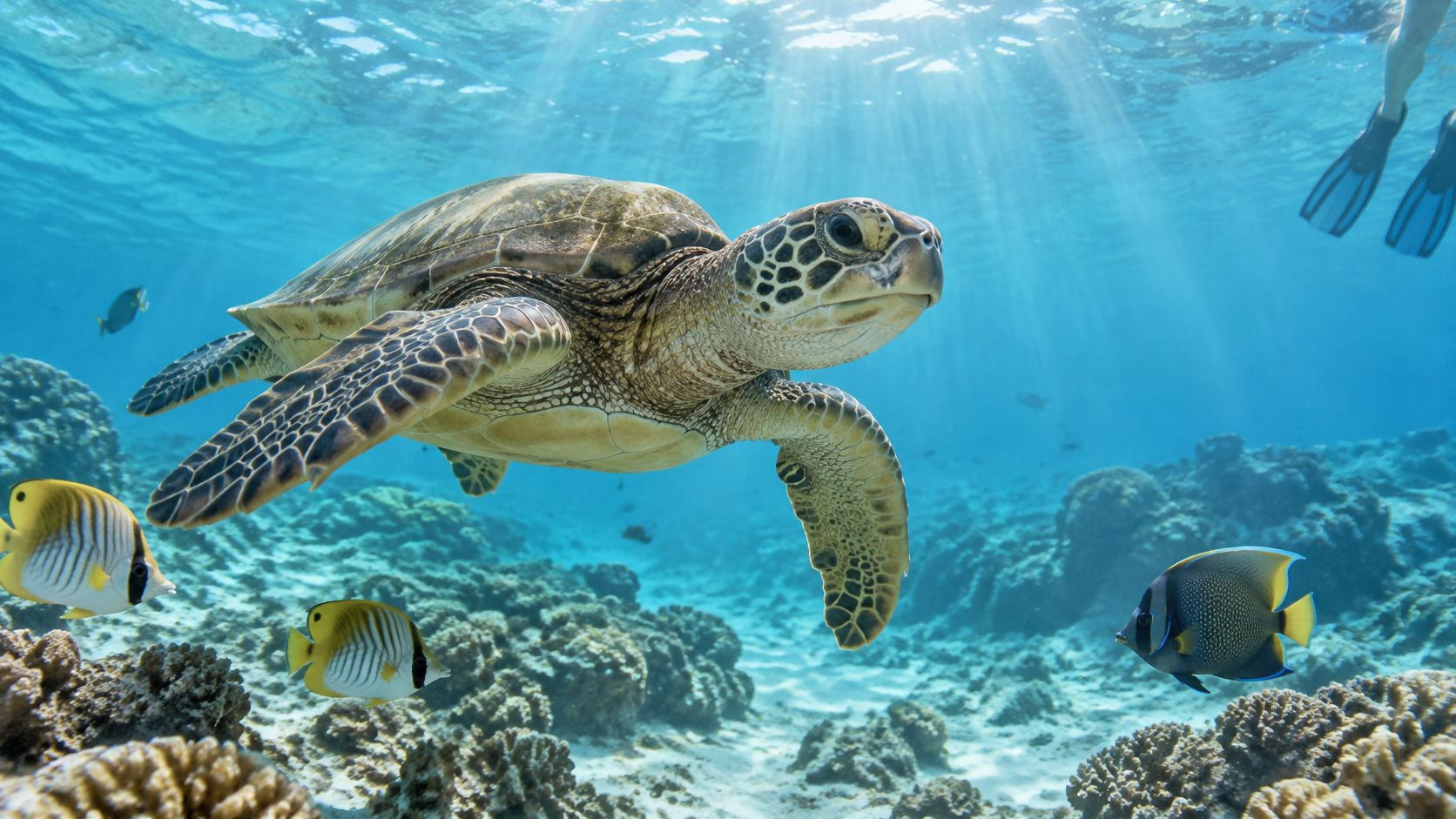
During the approximately 60-minute snorkeling portion, our crew points out Hawaiian green sea turtles, schools of colorful fish and habitat features. Look for butterflyfish, angelfish, parrotfish and invertebrates, with rays and, depending on the day, dolphins among the possible additional sightings.
Keep at least 10 feet (3 meters) from turtles, following NOAA's Hawaiʻi wildlife-viewing guidance. Never touch, chase, feed or block a turtle's path, and use camera zoom instead of approaching.
From the entry point to your first view
Say you're a beginner who has tested the mask but still feels uneasy looking into open water. Before entry, tell the guide. The useful next step is an equipment and flotation check followed by a short surface-skills orientation, not encouragement to hurry after the group.
Follow the crew's staggered entry instructions. Entering in sequence prevents swimmers from landing together or dropping into a turtle's resting area or travel route.
Once you're in, settle your breathing before searching for wildlife. Keep your face relaxed in the mask and use gentle kicks to reach the guide-defined observation zone.
The guide should position swimmers beside one another rather than letting everyone converge over the same animal. Rotating viewing positions gives guests a clear angle without forming a ring around a turtle.
- Watch across the reef: Look ahead as well as down, rather than fixating on the patch directly beneath your mask.
- Keep your fins quiet: Small, controlled movements reduce accidental contact with other swimmers and the reef.
- Stay with the observation group: Don't leave the guide's area because another swimmer points at something farther away.
Let behavior decide when to back off
Distance is a starting point, not permission to keep approaching until you reach a boundary. If a turtle changes direction, dives abruptly, speeds away or repeatedly surfaces after the group moves in, back off and give it more room.
Turtles sometimes swim within a few feet of snorkelers on their own. That isn't an invitation to remain close: end the viewing position, follow the guide's direction and open a clear route rather than surrounding the animal.
The Hawaiʻi Division of State Parks wildlife guidance advises giving turtles a wide berth and notes that they surface for air and can be observed from boats. Surface-oriented viewing is therefore a sensible approach, much like birdwatching from a trail rather than following a bird into its nesting cover.
For more context on the animal you're watching, read our guide to Hawaiʻi turtles. Recognizing ordinary resting, swimming and surfacing behavior makes the encounter more interesting than focusing only on getting a close photograph.
Distance rules for swimmers and boats
NOAA's viewing guidelines and distances distinguish the swimmer separation shown below from the recommendation that vessels remain at least 50 yards from turtles.
| Who | Minimum distance | What to do when a turtle appears |
|---|---|---|
| Snorkeler in the water | 10 feet (3 meters) | Hold your viewing position unless you need to retreat; let the turtle pass and don't follow |
| Tour boat or vessel | 50 yards, NOAA viewing guidance | Slow to no-wake on approach; put the engine in neutral when a turtle is near and allow it to pass |
| Camera use | Zoom in, don't move closer | Keep fins still and frame the shot from your position |
| Touching or feeding | Not permitted | Never touch, chase, feed or block a turtle's path |
Your most useful first-time habit is slow, calm breathing. If you can't settle, signal the guide instead of trying to solve the problem by kicking harder.
Is It Right for Beginners and Families
The trip suits many beginners and families because flotation, guide support and calm reef conditions can make surface observation manageable. But family-friendly doesn't mean universally suitable, and calm water isn't guaranteed.
A vest reduces the effort needed to stay afloat. It doesn't remove chop, poor visibility, current or the need to move back toward the boat when directed.
Match the person, not just the age
Say a family includes a confident-swimming parent, a six-year-old who doesn't swim and a grandparent who feels nervous in water. The parent may be ready after learning the equipment, while the child needs a separate assessment of vest fit and supervision, and the grandparent needs an honest discussion about open-water comfort.
Don't assume that the parent's ability makes the whole group ready. Before booking, ask us how non-swimmers are supported, whether staying aboard is an option, and what happens if someone wants to exit early.
Suitability by traveler type
| Traveler | Typical fit | What to confirm |
|---|---|---|
| Confident swimmer | Strong fit | Comfortable breathing through a snorkel and swimming unaided |
| Beginner adult with basic water comfort | Good fit with flotation vest | Request the in-water briefing and practice with the mask first |
| Non-swimming adult | Limited fit | Ask whether staying aboard is an option and how support works |
| Child aged 3 to 7 | Assess water skills and vest fit | Confirm vest fit, supervision level and whether the child can stay aboard |
| Child aged 8 and older with basic swimming | Good fit | Confirm the child can float and swim back toward the boat |
| Traveler prone to seasickness | Check before booking | Ask how the crew handles seasickness on the cruise |
These age bands are planning categories, not swimming qualifications. A child who meets the booking age still needs an appropriate fit and realistic supervision arrangements.
The Division of State Parks' turtle-viewing advice notes that turtles can also be seen from shore or boats. Entering the water isn't the only worthwhile way to observe them.
A successful family outing doesn't require every family member to snorkel.
Ask about rough-condition decisions, seasickness, panic and assisted early exits before paying. If offshore swimming isn't a comfortable match, our Honolulu activity guide can help you plan a different outing without pressuring anyone into the water.
Check Availability and Book Your Turtle Canyon Snorkel
Book this excursion if you want a guided reef outing and your group's water comfort matches the conditions and supervision needed. Choose based on readiness, not just the youngest permitted age.
Snorkel Turtle Canyon offers the Turtle Canyon Snorkel Adventure.
The adventure costs up to $109, lasts 2 hours and is open to guests ages 3 and up. There's no separate fee to access Turtle Canyon itself: the price covers the boat, crew, equipment and guided experience.
We offer a limited number of spots each day and recommend booking in advance, especially for a specific date or a short island stay. Review recent guest feedback, but use your group's needs to make the final decision.
- Confirm water comfort. Match each traveler to the suitability table and resolve supervision questions.
- Choose your date and departure. Leave room for check-in and transport around the excursion.
- Reserve your place. Read the confirmation carefully and save the Pier B arrival details.
Snorkel Turtle Canyon offers guided boat access to Waikiki's offshore reef, with snorkeling equipment, safety briefings and supervised wildlife observation. Visit Snorkel Turtle Canyon to plan a turtle snorkel that fits your family's swimming readiness and vacation schedule.