
You're in a Waikiki hotel, phone in hand, trying to pick a morning activity before the week fills up. One person in your group wants a honu in clear water. Another isn't sure about swimming in the open ocean. The listings sound sure of themselves, and almost none of them say what happens if the swell picks up or a turtle just isn't on the reef that day.
Turtle tours in Honolulu usually mean one specific outing: a guided boat snorkel to Turtle Canyon, a shallow offshore reef just off Waikiki where Hawaiian green sea turtles feed and rest. A beach entry will not get you there. The rest of this guide walks the trip the way a local crew would, including what we can plan for and what nobody can promise.
Table of Contents
- Turtle Tours in Honolulu at a Glance
- What Happens on a Turtle Canyon Snorkel Trip
- Who Should Join a Turtle Canyon Snorkel
- Honu Biology and Close-Encounter Etiquette
- Ocean Conditions and Timing That Make or Break a Trip
- Book Your Turtle Canyon Tour Early
Turtle Tours in Honolulu at a Glance
A Honolulu turtle tour, in practice, is a guided snorkel with Snorkel Turtle Canyon to that reef.
You can't walk out from the sand. Turtle Canyon sits just off Oahu's south shore, and we require a professional guided boat because the reef is offshore and can't be reached safely from the beach. Departures leave from a spot convenient to Waikiki hotels and resorts, so most guests are on the water without a long cross-island drive.
Turtle tour options compared
| Option | How You Reach the Reef | Turtle Sighting Odds | Best Fit | Main Limit |
|---|---|---|---|---|
| Guided boat snorkel to Turtle Canyon | Boat from Pier B, 1025 Ala Moana Blvd | We report turtles on 99% of trips | Families, beginners, first-timers | Two-hour format with about 60 minutes in the water |
| Snorkel from Waikiki Beach | Walk in from the sand | Lower than the reef, since Turtle Canyon offers deeper water and better visibility | Budget visitors and short dips | Crowds, surf conditions, and no guided briefing |
That 99% figure is our own operating record. It is a reason for optimism, not a guarantee on any single outing. Turtles move. A likely sighting and a promised one are not the same thing.
On the boat trip, masks, snorkels, fins, and flotation vests are included. You spend about an hour in the water inside a two-hour outing, which still leaves an afternoon in town. If you're sorting this against the rest of a short stay, our notes on things to do in Honolulu set the snorkel beside other half-morning plans.
Pick by swimming comfort, budget, and how many days you have. The reef beats the beach on clearer water and a better view of animals using the habitat, even though Turtle Canyon is a shallow reef and not a deep-water site. A shore dip costs less and needs less planning. It also puts you in crowds, surf, and water that hides the bottom.
What Happens on a Turtle Canyon Snorkel Trip
You check in, ride out, snorkel as a group, and come back. The whole loop is two hours, and the in-water piece is the part people remember.
From the pier to the reef
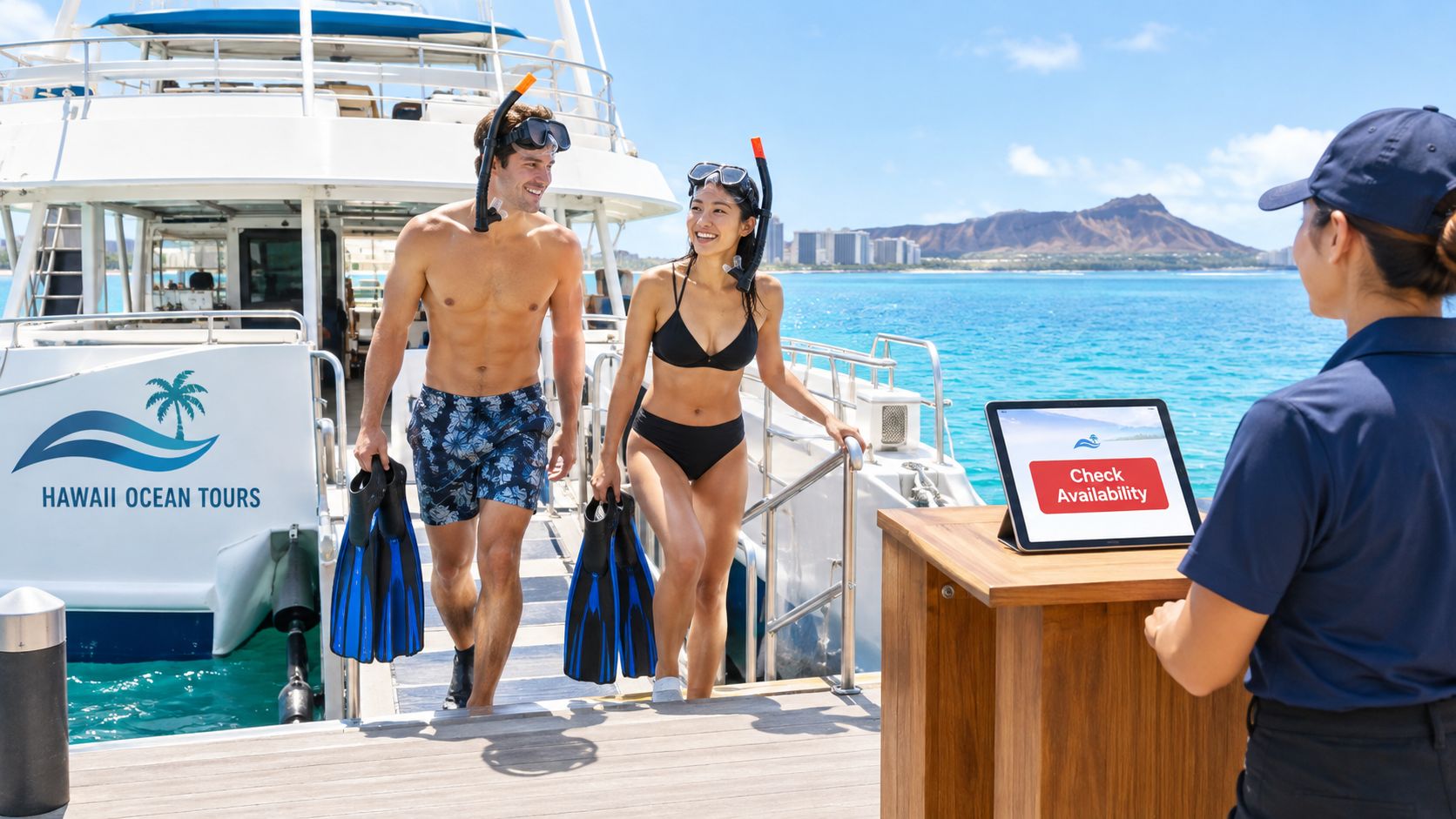
- You arrive at our office, 1025 Ala Moana Blvd, Pier B, Honolulu, HI 96814, early enough to finish check-in before the boat leaves. A towel, drinking water, and a waterproof bag for your phone cover what you need to carry.
- You board and cruise along the Waikiki coastline. The skyline and the south shore stay in view on the way out, so the ride is part of the morning rather than dead time.
- Crew members fit a mask, snorkel, fins, and a flotation vest. They check the seal and show you how to clear the snorkel. All of that gear is on the boat, so you don't rent anything in town. Put reef-safe sunscreen on before you arrive.
- You get the safety briefing and a marine-life orientation. Turtle rules are reviewed before every trip, before anyone is in the water and excited.
Before you leave the hotel: sunscreen on, swimwear under your clothes, and enough time that check-in isn't a sprint down the pier.
The hour in the water
- You enter at the reef. Guides point out green sea turtles, schools of butterflyfish and angelfish, rays, invertebrates, and, on some days, dolphins.
- You snorkel for about 60 minutes as a group. You stay near the guide and lean on the vest for support. During that hour, the crew's job is to point out animals and keep the group together, not to send you off alone.
- You climb back aboard, rinse the gear, and head in.
If a mask leaks, you say so. Fixing the fit early is easier than fighting it for the whole session.
Who Should Join a Turtle Canyon Snorkel
Family-friendly is not the same as suitable for every child. Age on a booking form, swimming skill, comfort in open water, and medical or sensory needs are four different questions. Passing one doesn't answer the others.
We accept guests ages 3 and up. That threshold only says a three-year-old may come. It doesn't say a particular three- or four-year-old will be calm with a mask on, or fine once the boat is away from the pier. Hawaii Ocean Safety guidance says people who can't swim should stay out of the water even with a flotation device. A vest and a nearby guide are a backup. They are not a substitute for basic water competence.
Who fits and what to check first
| Guest Situation | Suitability | What to Check First |
|---|---|---|
| Confident swimmer, age 8 and up | Good fit | Comfort with breathing through a snorkel |
| Child aged 3 to 5 | Eligible with close supervision | Water comfort and whether an adult stays in the water |
| Beginner with basic water comfort | Good fit with flotation vest | Can float, put the face in the water, and follow a guide |
| Non-swimmer | Not recommended in the water | Hawaii guidance says stay out even with a flotation device |
| Guest with medical or sensory needs | Ask the operator first | Medical conditions, hearing and eyesight, and ability to clear the mask |
| Guest who tires easily | Conditional | Ability to rest on the boat and exit the water without help |
How we help a nervous guest
Beginners join because we provide flotation gear and in-water support. A guide stays close, coaches one simple skill at a time, and lets someone pause. If your face needs to come out of the water, that is allowed. The vest is there so you can rest at the surface while you reset.
Before you pay, settle three practical points with us. Can this guest stay on the boat if the water doesn't feel right? How are children supervised once they're in? What sea state shortens or cancels the swim? Our sea turtle tours page is the place to match the outing to the people really coming, not to a generic family label.
A child who can float, put their face in, and stay with an adult is a different case from a child who panics at the ladder. Treat them as different cases.
Honu Biology and Close-Encounter Etiquette
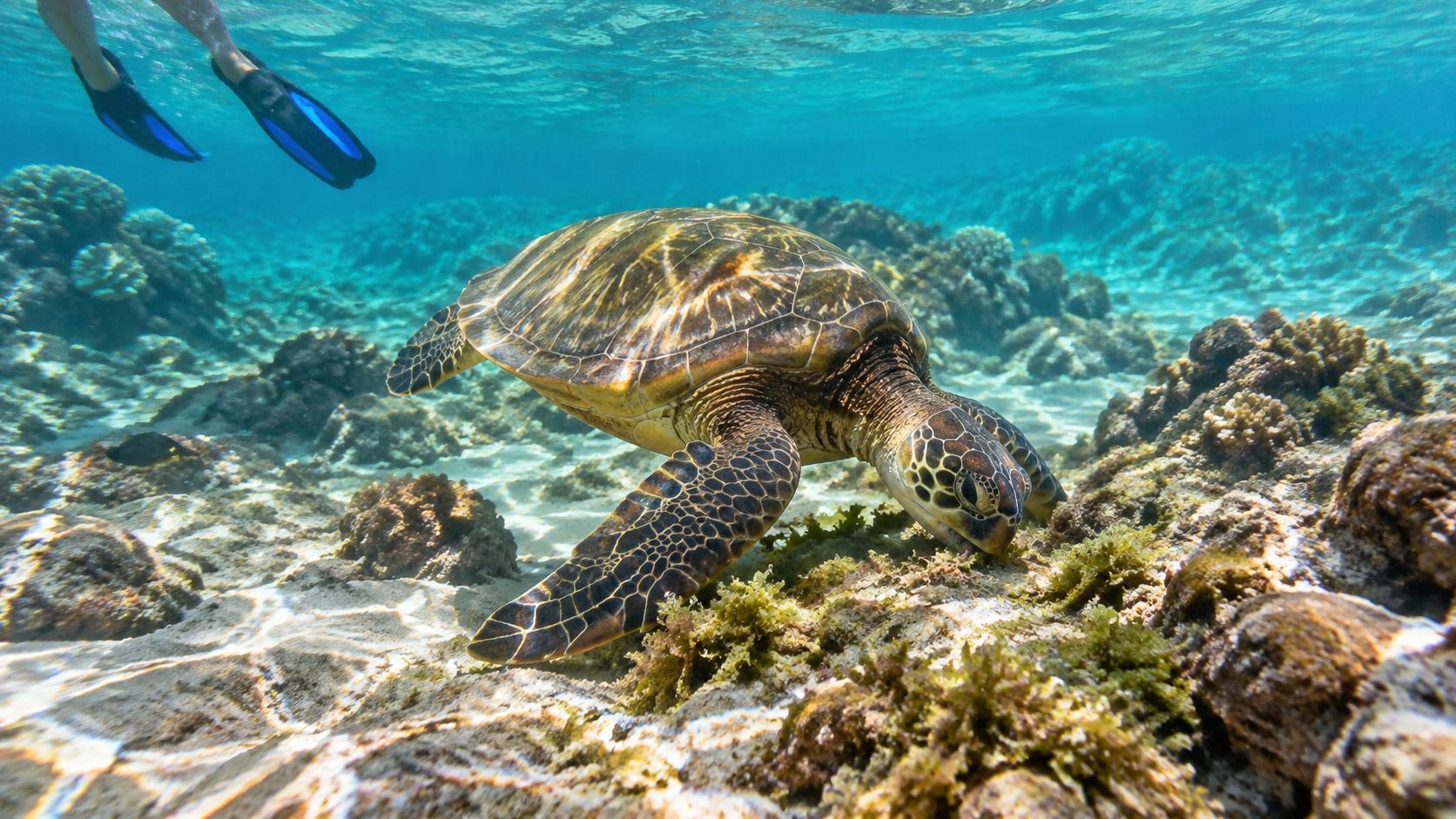
A honu over Turtle Canyon is usually busy feeding. It drops its head and grazes limu, the seaweed growing on the reef, then lifts to breathe. You've swum into its kitchen, and it has work to do.
What you're looking at
The Hawaiian green sea turtle, honu (Chelonia mydas), is the sea turtle people meet most often in the state. Hawaiʻi's Division of State Parks describes typical adults at about 2 to 3 feet in shell length. Grazing, steady swimming, and resting are normal behavior. A sudden turn, repeated dives, or a burst of speed means you've become the problem.
Sightings around Waikiki exist because of protection, not because turtles were always this easy to find. NOAA Fisheries recounts how commercial harvest and other pressures had severely depleted the population before safeguards began, then ties the recovery that followed to risks that haven't gone away: habitat loss, fishing-line entanglement, light pollution, and climate change. The species remains federally threatened, and that same NOAA account estimates growth of about 5.4% per year from 1973 onward, with nesting counts that still bounce around year to year.
Hawaiian green turtle recovery milestones
| Year or Period | Milestone | What It Means for Visitors |
|---|---|---|
| 1973 | Scientific monitoring begins | Creates a baseline for measuring population change |
| 1974 | State protection begins | Start of legal safeguards for the species |
| 1978 | Federal protection under the U.S. Endangered Species Act | The species is still federally threatened today |
| First 10 years of monitoring | Average of 92 nesting females per year at East Island | Starting point for the recovery story |
| About 30 years later | Average of 411 nesting females per year | More than a fourfold increase |
| 2011 | Record 808 nesting females | Highest count on record |
The table tells a comeback story. It does not tell a story of abundance.
Why a Waikiki sighting still asks for space
NOAA's Hawaiian green turtle brochure places this genetically distinct Central North Pacific population at fewer than 4,000 total nesting females. Seeing honu often off Waikiki doesn't mean they're common everywhere, and it doesn't mean an individual can be approached. Our Hawaii turtle background is the longer version of that story.
We see sea turtles on 99% of our trips. That's a track record, and treating it like a guarantee is how people end up chasing a turtle to force the look they came for. Turtles often swim within a few feet of snorkelers on their own, and that close pass counts as a good encounter only if the turtle chose it. The crew's job is to have you give them space and let the meeting stay natural.
Before every trip we explain the same rules: don't touch, don't chase, and stay at least 10 feet (3 meters) away, in the water and on land. NOAA and Hawaiʻi's boating authority treat that distance as a recommended viewing standard rather than an automatic legal line. Getting closer can still be illegal harassment if you disturb the animal or change its natural behavior. A measured gap doesn't save a bad encounter.
If your next kick makes the turtle change its next move, the encounter is already too close.
Stay still and let the turtle pass. Don't follow it, and don't block the path to the surface. A turtle has to breathe, and a ring of people overhead is stress even with no hands on the shell. Kick gently. Stay on one side instead of circling. End it if the turtle turns sharply, dives over and over, or accelerates away.
Marine Life Conservation Districts generally restrict taking living material, including coral and algae, and nonliving habitat such as sand, rocks, and coral skeletons. Don't stand on the reef, and don't pocket a shell. A good sighting is the one where the honu keeps feeding.
Ocean Conditions and Timing That Make or Break a Trip
Morning is usually the better window. Hawaiʻi ocean-safety officials say conditions and visibility are often better then, and marine life may be more active. The same guidance says to skip dawn, dusk, and murky water, and to check conditions before you enter. If you're unsure, ask a lifeguard.
We schedule trips around favorable conditions, with the emphasis on calmer mornings. Calm, turquoise water is exactly what makes the reef workable for a first-timer and a confident snorkeler on the same boat. Wind that builds later in the day turns an easy float into a tiring one.
Conditions to check before you go
| Condition | Go | Reconsider or Skip |
|---|---|---|
| Surf | Small, gentle swell | High surf |
| Wind | Light breeze | Strong winds |
| Shorebreak | Minimal waves at the entry | Heavy shorebreak |
| Current | Calm water | Strong currents |
| Visibility | Clear turquoise water | Murky water |
| Time of day | Morning | Dawn or dusk |
A simple booking plan
Spots are limited each day, so reserve ahead when you care about a specific date or you're only on Oahu for a short stay. Book the morning you really want. Check the ocean the day before and again that morning. Before you pay, ask us how a weather or sea-state cancellation is handled, so a blown-out day doesn't strand the rest of the trip.
High surf, strong winds, heavy shorebreak, and strong currents are the four conditions ocean-safety officials flag as poor for snorkeling. None of them is a surprise you should discover at the ladder. A rescheduled morning beats a miserable hour fighting chop.
The same safety guidance also says not to touch coral or marine life, not to feed animals, and not to stand on the reef. Those habits matter as much on a calm day as on a rough one.
Book Your Turtle Canyon Tour Early
The Turtle Canyon Snorkel Adventure costs up to $109, lasts 2 hours, and is open to guests ages 3 and up. There is no separate fee to enter Turtle Canyon. The price covers the boat, the crew, the equipment, and the guided time on the reef.
Because each day has a limited number of places, waiting until you're already in Waikiki often means the morning you wanted is gone. Advance booking matters most when the date is fixed or the island stay is short. If the backup plan was a walk-in snorkel off Waikiki Beach, remember that the reef trip is the one that actually reaches the offshore habitat.
Confirm this before you pay
- Date and morning departure: Lock the day, not a vague "sometime this week."
- Every child's age and swimming ability: Eligibility at age 3 is not a skills test.
- A flotation vest for each guest who wants one: Gear is included, and you should still say who needs the extra support.
- Reschedule and weather steps: Know what we do if the sea state is wrong before any money moves.
If your group can float, follow a guide, and wants a reef visit rather than a beach dip, take the earliest suitable morning. Questions that don't fit in a checkout form are answered in our turtle snorkel FAQ.
Snorkel Turtle Canyon runs guided boat snorkels from Waikiki to Turtle Canyon so you can watch Hawaiian green sea turtles and reef fish with a crew, included gear, and clear distance rules. If that is the morning you want, check dates and space with Snorkel Turtle Canyon before the calm departures fill.