
You're in your Waikiki hotel, deciding whether turtle snorkeling will be the highlight of your stay or the activity that leaves someone in your group overwhelmed. The photos show clear water and turtles gliding past, but they don't explain the boat ride, the gear, or what happens when a child gets nervous. A good decision starts with understanding the experience as a reef visit, not a promise of a close-up wildlife encounter.
Table of Contents
- Turtle Snorkeling in Waikiki at a Glance
- How a Guided Turtle Canyon Trip Unfolds
- What to Bring and What the Trip Provides
- Respectful Turtle Viewing and Distances
- Beginner and Family Safety on the Reef
- Book Your Turtle Canyon Trip Before Your Visit
Turtle Snorkeling in Waikiki at a Glance
Say you leave your Waikiki hotel in the morning and head to Pier B at 1025 Ala Moana Blvd. Check the route before deciding to walk, since the distance from your hotel matters when you're carrying towels and traveling with children. At the pier, you board a boat bound for Turtle Canyon, a shallow offshore reef just off Oahu's south shore near Waikiki.
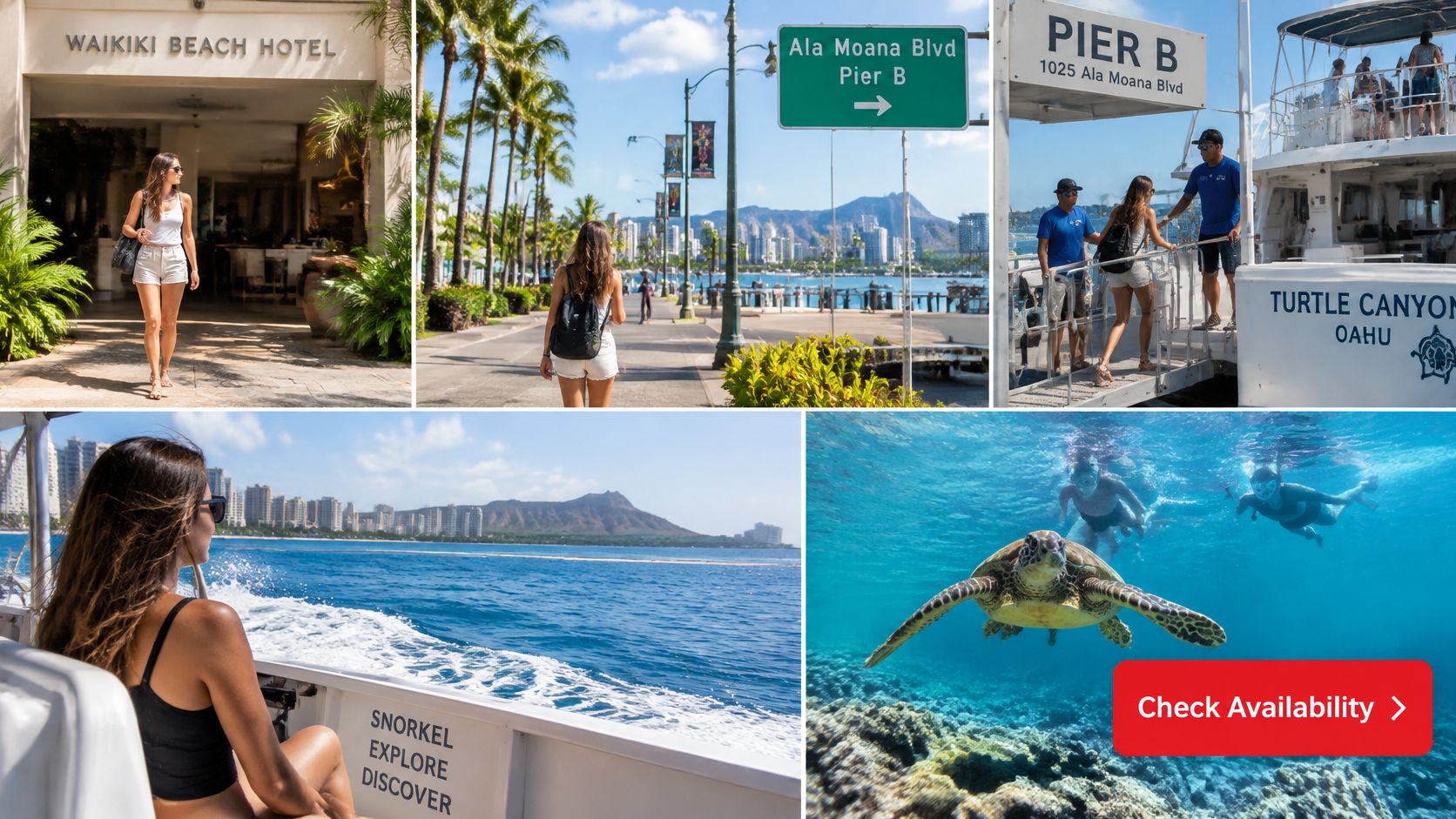
This is a guided, two-hour snorkeling outing with crew support, equipment, and a safety briefing. The boat isn't just a convenience: Turtle Canyon sits offshore and can't be accessed safely from the beach. Although the reef is described as shallow, that doesn't mean guests can stand on the bottom or treat it like a swimming pool.
Why these encounters carry responsibility
Hawaiian green turtles were close to collapse in the early 1970s, before Hawaii protected them in 1974 and federal protection followed in 1978, according to the NOAA-hosted conservation history, which also records nesting females at East Island rising from an average of 92 annually during the first decade of study to a record 808 in 2011. Those figures describe a nesting population, not the number of turtles you'll see off Waikiki.
You're visiting the habitat of a recovering, protected animal, not entering an attraction where wildlife performs on schedule.
We see sea turtles on 99% of our trips, based on operating history, but that isn't a guarantee for an individual departure. Turtles feed, rest, and move through their habitat on their own terms.
If you're still choosing between observing from land and entering the water, our guide to Turtle Beach on Oahu helps distinguish those experiences. The practical decision is whether a guided boat outing suits your schedule, your group's water confidence, and your willingness to let wildlife set the pace.
How a Guided Turtle Canyon Trip Unfolds
Allow two hours for the excursion itself, with approximately 60 minutes dedicated to snorkeling. Keep time outside that window for getting to the harbor and following the check-in directions in your booking confirmation. Don't plan your arrival around the boat's departure time alone.
From the pier to the reef
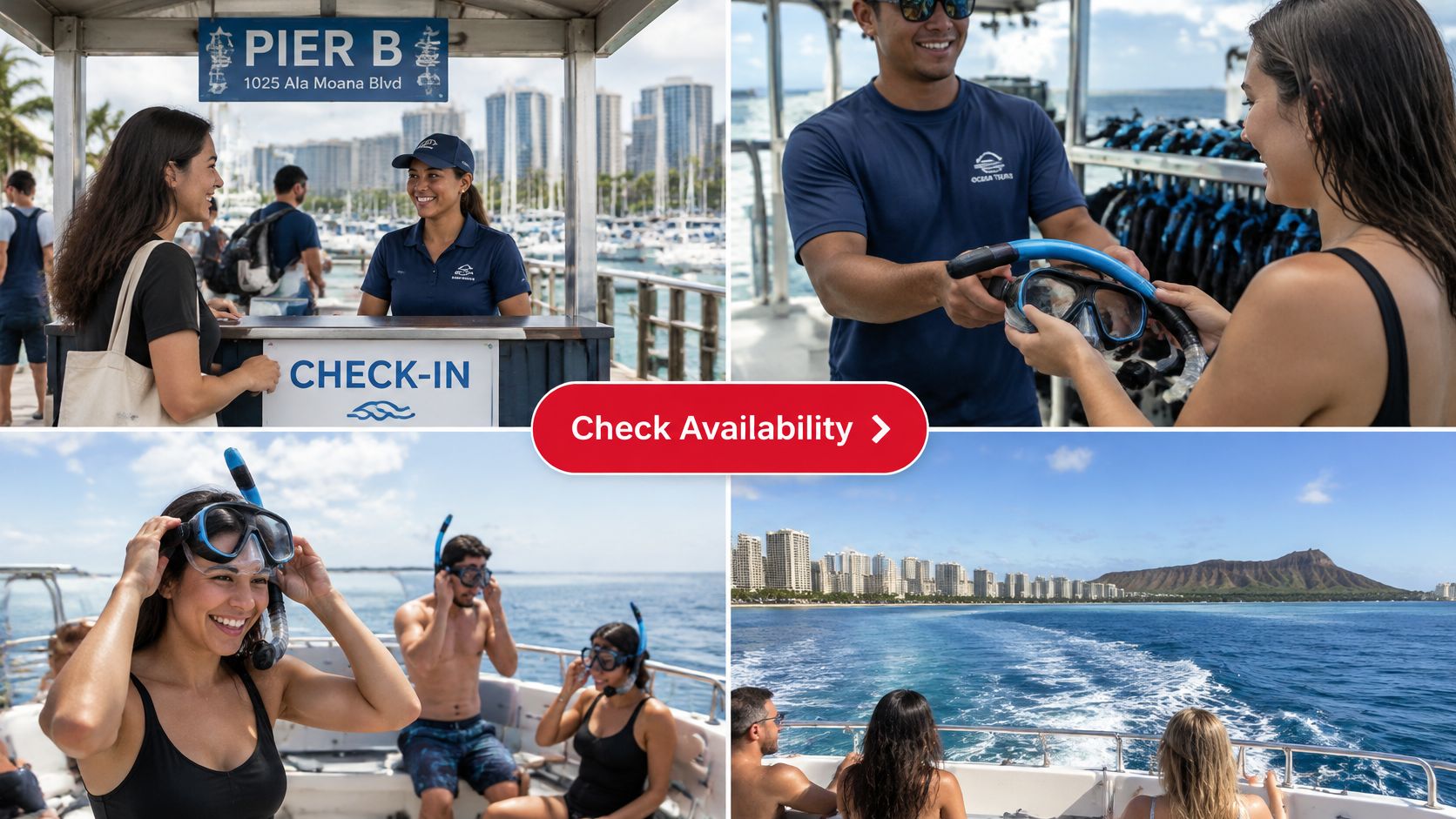
Check in at Pier B. Head to 1025 Ala Moana Blvd, Honolulu, a short trip from Waikiki hotels, and follow your confirmation's arrival instructions. Arriving without a last-minute rush gives you time to mention nervous swimmers, ask about the day's conditions, and organize belongings before boarding.
Get fitted and listen to the safety briefing. Masks, snorkels, fins, and flotation vests are ready for guests, while the crew explains how entry, group supervision, and returning to the boat will work. This is the moment to say that a mask pinches or that you've never breathed through a snorkel, rather than trying to solve it over the reef.
Board and travel along the Waikiki coastline. The cruise gives you skyline and south-shore views while the crew explains reef etiquette and turtle protection. Boat transport removes the need for an unsafe swim from the beach, but the ride also gives you time to understand the setting before entering open water.
In the water and on the way back
Orient yourself at the offshore reef. The crew points out turtles, schools of colorful reef fish, and other marine life, helping you recognize what you're looking at rather than scanning for a shell. Look across the reef as well as downward, and listen for instructions about where the group should position itself.
Enter under supervision and settle into snorkeling. During the approximately 60-minute water portion, guides remain nearby and help guests follow the marine life without crowding it. That's a window for exploring the reef, not permission to spend the entire session hovering over the same turtle.
Return to the boat and head to shore. Follow the crew's exit instructions, take your time at the boarding point, and dry off on deck before the return cruise. The coastline becomes part of the experience again, rather than something you missed while adjusting your mask on the way out.
A satisfying trip might include turtles viewed clearly from a respectful distance, fish moving through the reef, and the Waikiki skyline on the return. It doesn't require a turtle to approach your face or remain beside you for a photograph.
Practical rule: Sort out breathing, mask comfort, and flotation before concentrating on wildlife. If you're uncomfortable, tell the guide instead of trying to keep up.
You also don't have to use every available moment in the water. Returning to the boat when you've had enough is a sensible choice, particularly if you're getting cold, tired, or distracted by equipment.
What to Bring and What the Trip Provides
You don't need to buy a snorkeling kit for this trip. We supply the necessary professional equipment, so your packing should focus on sun protection, dry belongings, and comfort before and after the water.
Gear provided on board and what to bring
| Item | Provided on the boat | Bring yourself |
|---|---|---|
| Snorkel mask | Yes, sanitized | Optional, if your own fits better |
| Snorkel | Yes | Optional |
| Fins | Yes | Optional, subject to crew approval |
| Flotation vest | Yes | No |
| Reef-safe sunscreen | No | Yes |
| Swimsuit and towel | No | Yes |
| Hat or sunglasses | No | Yes |
Wear your swimsuit under your clothes when you leave the hotel. That simplifies preparation at the harbor and keeps you from needing a full change before getting wet.
Bring reef-safe sunscreen and use clothing, such as a sun shirt, for additional coverage. The aim is to protect your skin while reducing unnecessary exposure of the reef to harmful sunscreen ingredients. Don't treat a reef-safe label as a reason to apply more than you need or ignore the product's directions.
Fit matters more than ownership
You're welcome to bring a personal mask or snorkel if you prefer your own equipment. A familiar mask can be useful, but let the crew check its fit and condition before entry rather than assuming that personal gear must work better.
A comfortable mask should seal without an excessively tight strap. Move hair away from the skirt, check that the strap isn't twisted, and mention leaks early. Tightening a poorly fitting mask harder usually isn't the most useful fix.
Keep the easily forgotten items together:
- Dry bag: Protect your phone, keys, and other small essentials from splashes.
- Change of clothes: Pack something dry for the trip back to Waikiki.
- Towel: Keep it accessible for drying off after boarding, rather than buried beneath everything else.
A hat and sunglasses help on the boat, but secure them before leaning over the water. Leave unnecessary valuables at your accommodation.
For most visitors, the immediate task is checking what's already in the hotel room or suitcase. If you have swimwear, a towel, appropriate sunscreen, and sun protection, there's no need to make a separate equipment-shopping trip.
Respectful Turtle Viewing and Distances
The question worth asking on a turtle snorkel is whether the animal can keep doing what it was doing before you arrived. Distance is the tool that makes that possible.
A snorkeling survey of nine patch reefs in Kaneohe Bay found green turtles most abundant in northern and offshore sections, with observed behavior approximately 90% resting and 10% foraging; the accompanying behavioral context notes that resting adult green turtles can hold their breath for up to three hours, although they typically surface every 15 to 30 minutes. That survey wasn't conducted at Turtle Canyon, so its percentages shouldn't be treated as a description of every Waikiki encounter.
The lesson still applies. Motionless doesn't mean available for inspection. Treat a resting turtle the way you'd treat a sleeping neighbor. You can stay present. You don't pull the blanket back to get a better look.
Distance is the starting point
Hawaii's Department of Land and Natural Resources sea-turtle guidance recommends staying at least 10 feet, or 3 meters, from green turtles in water and on land, and explains their protection under the federal Endangered Species Act. Harassing a turtle can violate the law, and the viewing recommendation shouldn't be confused with permission to interfere from just beyond that distance.
Turtle viewing distances and rules by situation
| Situation | Minimum distance or action | Guidance source |
|---|---|---|
| Swimmer and green turtle in the water | At least 10 ft (3 m) | Hawaii DLNR and NOAA Fisheries sea-turtle guidance |
| Vessel near a turtle | No-wake speed or engine in neutral; do not chase, encircle, or trap | NOAA Fisheries vessel-viewing guidance |
| Any turtle | No touching, chasing, feeding, encircling, or trapping | NOAA Fisheries Hawaii viewing guidelines |
These recommendations address different situations, and 10 feet is a floor. A resting turtle that hasn't noticed you deserves far more room than the minimum, and so does a swimming turtle with somewhere to go. When several snorkelers gather near the same animal, each person can be past the line while the turtle still ends up surrounded, so extra room prevents crowding. Follow the crew's direction when they ask you to give more space.
The gap is the easy part. Watch the behavior. A turtle shouldn't have to change direction to accommodate your photograph.
A simple routine for an encounter
Begin by settling at the surface, identifying the turtle's direction, and leaving its route open. Position yourself where you can watch without drifting into its path or hovering directly over its route to the surface. A resting turtle still needs air, and somewhere in that 15-to-30-minute cycle it will come up for a breath. If your fins are parked between the animal and the surface, you've become an obstacle.
- Hold your position: Observe from a stable place rather than following every movement.
- Protect the reef: Keep fins off coral and avoid standing on the bottom.
- Leave resting animals alone: Never dive toward a turtle to inspect it or improve a photograph.
- Keep an open side: Don't join a tight circle around an animal.
- Let the encounter end: Allow the turtle to surface, swim away, or disappear from view without pursuit.
Turtles often swim within a few feet of snorkelers on our trips, and our crew guides guests to hold a respectful, passive distance while natural interactions unfold. If a turtle swims toward you, stop, hold still, keep your hands to yourself, and let it pass. Then move away calmly when you can do so without cutting across its route. If there's room to create space earlier, follow your guide's direction and do that.
Boat positioning matters too. Operators must avoid chasing, encircling, or trapping turtles between a vessel and shore, and use no-wake speed or neutral as appropriate to let an animal pass safely. Nobody should feed a turtle to create an encounter.
Our guide to Hawaii's turtles provides more background on the animals you're watching. In the water, keep the decision simple: if your movement changes the turtle's path, you're too close.
Beginner and Family Safety on the Reef
A calm-looking surface doesn't prove that snorkeling is safe, and a supervised tour doesn't remove every risk. Current, visibility, fatigue, and a swimmer's ability still matter even when the water looks inviting from the deck.
Hawaii Ocean Safety identifies high surf, strong winds, heavy shorebreak, and strong currents as poor snorkeling conditions, and recommends buddy snorkeling, morning sessions, avoiding murky water, and exiting immediately if you feel uncomfortable. Morning is a sensible preference, not a guarantee that the ocean will cooperate.
Family-friendly isn't universally suitable
We accommodate guests ages 3 and up, with flotation support available, but an age threshold doesn't establish an individual child's readiness. Young or inexperienced children need continuous adult proximity in the water, alongside the crew's supervision.
A flotation vest helps support you at the surface. It doesn't teach breathing through a snorkel, move you against a current, or replace swimming ability. Think of a seatbelt: it provides protection, but it doesn't drive the car.
Watch for rapid breathing, repeated water in the snorkel, or gripping the vest tightly. These aren't diagnoses by themselves, but they're reasons to stop, check in, and get help rather than insisting someone continue. A child who becomes unusually quiet or stops responding comfortably also needs your attention.
Make the entry decision together
Use this check before anyone enters, and reassess if conditions or confidence change:
- Surface conditions: Is the water choppy, and is the crew satisfied that entry is appropriate for your group?
- Energy: Is anyone already tired, unwell, or reluctant? Don't use a paid booking as a reason to override that.
- Child readiness: Can each child float comfortably with support and manage a snorkel without distress? If not, tell the crew before attempting the open-water portion.
- Adult attention: Is an adult ready to stay close to each young or inexperienced child instead of focusing on a camera?
- Exit confidence: Does everyone understand how to signal for help and return to the boat?
If you're comparing locations for a family outing, our Turtle Bay snorkeling guide can help you distinguish that area from this offshore Waikiki experience. A familiar place name isn't enough to judge suitability.
Disclose weak swimming ability before boarding. Tell the crew what that means in practice, whether you can float but tire quickly, haven't swum in open water, or feel anxious with your face submerged. Clear information helps the crew assess what support is appropriate, without anyone having to discover the limitation away from the boat.
Book Your Turtle Canyon Trip Before Your Visit
Book when the outing fits your group, not because a turtle photograph looks appealing. A good choice balances available time, water confidence, and a willingness to observe wildlife without controlling the encounter.
Before selecting a departure, answer these questions:
- Does the schedule fit? Leave room for harbor travel and check-in rather than squeezing the outing between tightly timed reservations.
- Is everyone ready for the water? Consider the least confident person's comfort and the day's conditions, not just the strongest swimmer's enthusiasm.
- Will everyone follow the wildlife rules? Children and adults should understand that touching, pursuing, and blocking turtles aren't part of the experience.
Snorkel Turtle Canyon offers a limited number of spots each day. The Turtle Canyon Snorkel Adventure costs up to $109, lasts two hours, and is open to guests ages 3 and up.
Set expectations before reserving
We recommend booking in advance, especially if you need a specific date or have a short island stay. Leaving the reservation until your last available morning gives you fewer options if your preferred departure is full.
Sightings are never guaranteed. Reserve with the expectation of visiting a living reef, where fish, habitat, and coastal scenery also deserve your attention. A turtle that stays distant or leaves the area hasn't failed to deliver an experience; it's behaving as a wild animal should.
Ask our crew what happens if conditions are unsuitable on the day, and review the terms attached to your reservation before paying. Don't assume that every weather concern leads to the same cancellation, rescheduling, or refund outcome.
If you're planning the rest of your stay, our things to do in Honolulu guide can help you choose activities around your harbor visit. Keep enough flexibility that you won't feel pressured to hurry off the boat or push through fatigue.
Pick a morning date that works for your group, check availability, and pack your swimsuit, towel, reef-safe sunscreen, and sun protection. Prepare for a quiet observation of the reef, and let any turtle encounter happen on the animal's terms.
Snorkel Turtle Canyon offers guided boat snorkeling off Waikiki with equipment, a safety briefing, and in-water guidance for observing turtles and reef fish respectfully. Visit Snorkel Turtle Canyon to choose your date and plan a reef visit that suits your group's comfort in the water.