
You're in Waikiki, checking activities on your phone, and every search seems to give the same turtle trip a different name. One listing says Turtle Island Honolulu, another says Turtle Canyon, and the photographs make it hard to tell whether you're booking a beach visit or stepping off a boat into open water. Before you choose a departure, get that distinction straight. It affects everything from your ride to the harbor to whether everyone in your family should enter the water.
Table of Contents
- What Visitors Mean by Turtle Island Honolulu
- Where Turtle Canyon Actually Sits Off Waikiki
- Why the Honu Population Matters for Visitors
- What a Guided Turtle Canyon Trip Looks Like
- The Ten-Foot Rule and How to Snorkel Around Turtles
- Who the Trip Is Actually Suitable For
- Why Going With a Guide Beats Trying It Yourself
- Booking a Turtle Canyon Trip and What Comes Next
What Visitors Mean by Turtle Island Honolulu
Most visitors searching for Turtle Island Honolulu mean Turtle Canyon, the offshore snorkeling destination near Waikiki. You're not booking transportation to a little island where you can walk around, put down a towel, and wade in. You're booking access to an underwater reef site.
The names blur when activity listings favor memorable turtle-related language over precise geography. A map result can add to the confusion if its pin identifies a booking office or departure dock rather than the reef itself. Use the destination name to choose the experience, then use your booking confirmation to find the boat.
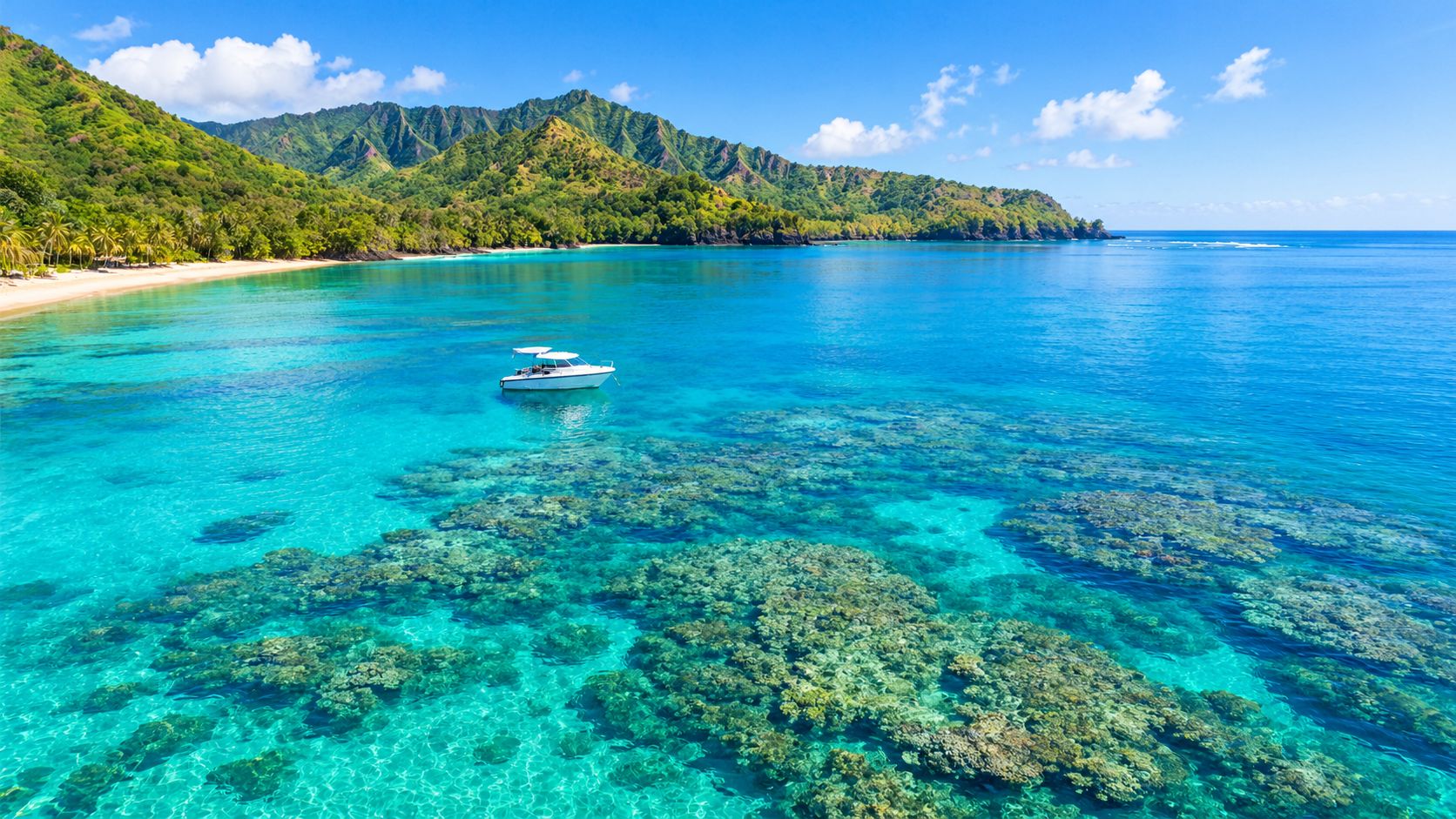
A reef encounter rather than an island visit
Turtle Canyon is associated with cleaning-station activity, where smaller reef fish attend turtles around the reef. Hawaiian green sea turtles, known locally as honu, move through this habitat on their own schedule. That distinction matters: the crew can position guests for observation, but it can't arrange a turtle's movements.
For a first visit, check that the listing describes the experience you want:
- Destination: Look for Turtle Canyon off Waikiki, not a turtle-themed coastal outing.
- Water activity: Confirm that the trip includes guided snorkeling rather than sightseeing from the deck.
- Access: Expect a boat departure and an offshore entry, not a beach meeting followed by a shallow-water walk.
- Wildlife expectations: Treat sightings as encounters with free-ranging animals, not a performance.
Book the reef experience, not the promise of getting close enough to touch a turtle.
The useful mental picture is a boat holding position near a reef, guests floating at the surface, and a guide helping everyone look without crowding the animals. You may spend part of the swim watching fish or waiting for a better viewing angle. That isn't wasted time. Patient observation is more appropriate than chasing an animal to manufacture a photograph.
Where Turtle Canyon Actually Sits Off Waikiki
Turtle Canyon sits offshore from Waikiki, separate from the beach swimming areas visitors can enter from the sand. Its position makes the crossing part of the excursion, not an optional transfer you can replace with a determined swim.
A shoreline view can be misleading. From a hotel balcony, the ocean may look flat and the boats may appear close together. At water level, you still have to manage movement, orientation, fatigue, and the return journey. Don't use apparent distance from shore as a measure of safe swimming access.
Understand the underwater setting
Think of the reef as a series of underwater features rather than a single attraction beneath a marker buoy. Ledges and habitat features give a guide places to look, but turtles aren't fixed to those locations. A useful viewing position depends on where the animals are and how the group can remain clear of them.
You don't need to dive down to make the experience worthwhile. Surface snorkeling allows you to watch what happens below without turning the outing into a breath-hold contest. If an animal moves out of view, let the guide decide whether repositioning makes sense.
| Planning question | Practical implication |
|---|---|
| Is this a shore-entry activity? | No. Choose transport designed for an offshore snorkeling visit. |
| Is the reef the same as the departure location? | No. Navigate to the confirmed dock, not the offshore destination. |
| Can conditions change the plan? | Leave room for the captain to adjust the operation. |
| Should another beach substitute automatically? | No. Evaluate each location's access and conditions separately. |
Hanauma Bay and North Shore beach locations aren't interchangeable versions of this trip. Don't assume that advice about a beach entry, parking arrangement, or seasonal swimming opportunity applies to an offshore boat excursion.
For Waikiki visitors, the useful logistical question is where the operator boards. A central Honolulu or Kewalo Basin departure can simplify the day, but check your route, parking instructions, and check-in requirements before leaving the hotel. A short crossing doesn't excuse arriving at the wrong harbor.
Why the Honu Population Matters for Visitors
The turtle you see through your mask belongs to a population with a difficult conservation history. Intensive harvesting severely reduced Hawaiian green turtles in the early twentieth century, while state and federal protections introduced in the 1970s helped support their recovery, according to Hawaii's Division of Aquatic Resources.
Recovery is measurable, but it isn't permission to relax wildlife protections. NOAA's account of turtles, tourism, and traffic describes statewide nesting-population growth of roughly 3% to 5% annually, alongside continuing risks from human activity. An increasing population can still need careful management.
Recovery doesn't make an individual encounter harmless
A visitor sees a brief moment: a turtle resting, swimming, or moving toward the surface. The animal experiences the whole sequence of boats and people around it. The question isn't whether your photograph takes only a moment, but whether your actions interrupt what the turtle was doing.
All sea turtles found in the United States are protected under the Endangered Species Act, which prohibits harassment, harm, possession, and killing, as explained in NOAA's Pacific Islands sea turtle protection guidance. A wildlife encounter isn't an exception to that framework.
- Resting matters: Don't interpret a stationary turtle as an invitation to move closer.
- Movement matters: Leave an unobstructed route instead of gathering around the animal.
- Feeding behavior matters: Observe without offering food or trying to attract attention.
- Your guide's instructions matter: A direction to stop or back away protects the encounter, not just the schedule.
For more background before boarding, the Hawaiian turtle guide provides a useful starting point for understanding the animals you hope to observe.
The conservation story makes the trip more meaningful, not less enjoyable. You aren't visiting a petting attraction. You're entering habitat used by protected wildlife, and the quality of the experience depends partly on how well everyone leaves that wildlife alone.
What a Guided Turtle Canyon Trip Looks Like
A good excursion starts with clear dock instructions, not a hurried search for equipment while the boat pulls away. Confirm the boarding location in your reservation, arrive ready to check in, and tell the crew about swimming concerns before departure. Don't wait until you're standing beside the entry point.
At equipment fitting, a comfortable mask matters more than choosing one quickly. Explain any leaking or awkward fit before the group gets underway. Ask whether a wetsuit is available if you want one, rather than assuming it comes with the standard snorkeling equipment.
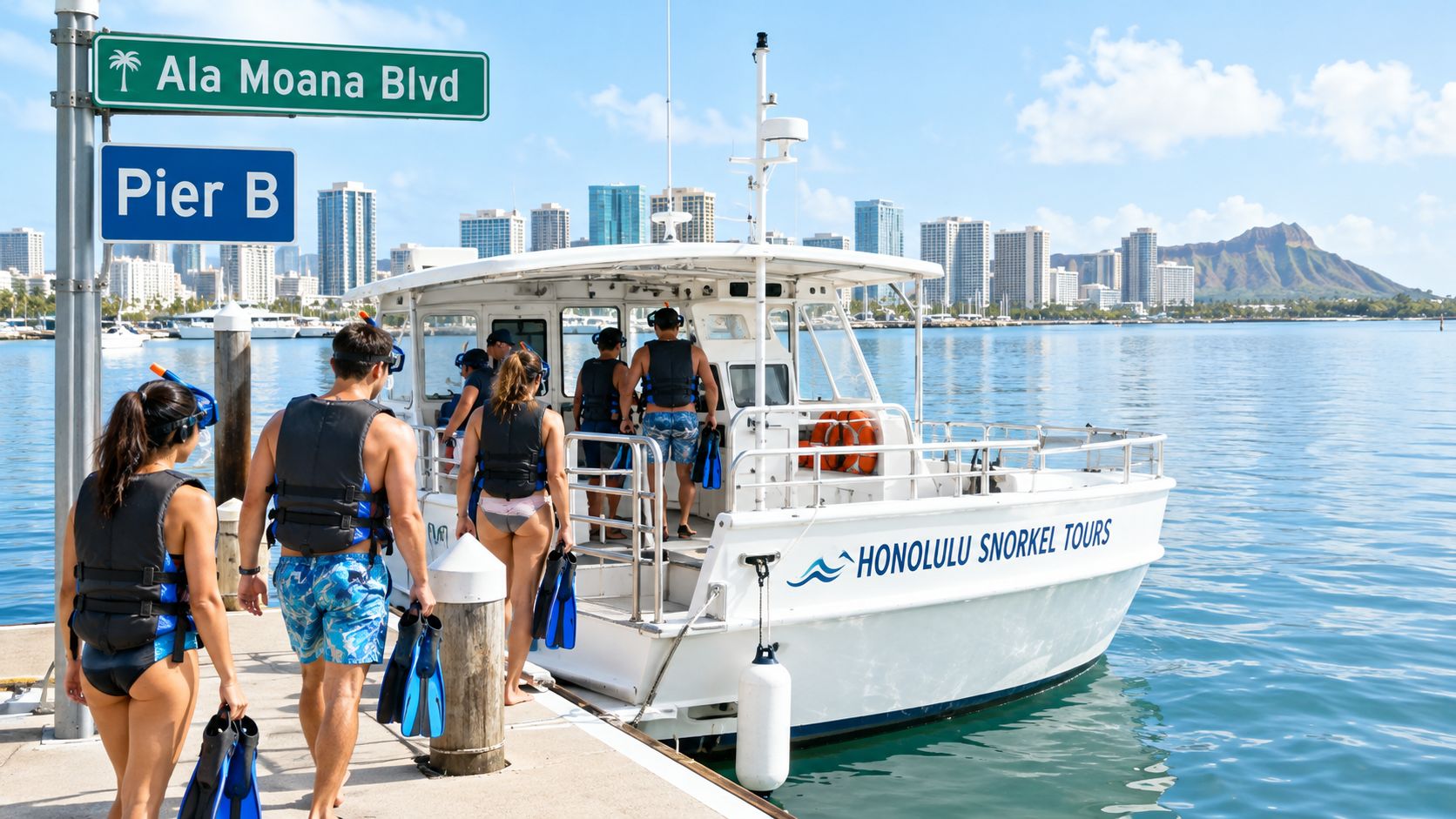
From departure to water entry
The coastal ride gives you time to settle into the boat and take in the Waikiki skyline and south shore. Use that time to listen. The safety briefing should explain entry, flotation, guide signals, boundaries, and how to return aboard.
At the reef, the transition from deck to water can feel more significant than the snorkeling itself. The boat moves beneath your feet, your fins change how you step, and you have to follow instructions while handling unfamiliar gear. A controlled entry is better than rushing because someone behind you looks ready.
- Before entry: Know where the guide will be and how to request help.
- At the surface: Settle your breathing and check your mask before following the group.
- During the swim: Watch the guide as well as the wildlife.
- On return: Wait for instructions at the ladder or swim step instead of crowding it.
What the guide should actually do
An in-water guide should do more than point toward a turtle and swim away. Look for active group management: checking positions, helping hesitant guests, identifying reef fish, and preventing swimmers from closing around an animal.
Don't confuse guided snorkeling with a required descent to the reef. You can remain at the surface, supported by appropriate flotation, while observing below. Any pressure to dive down for a better photograph is a poor fit for a beginner-focused experience.
Before you book: Ask how the crew handles a guest who enters the water, feels uncomfortable, and wants to return immediately.
Back aboard, follow the crew's instructions for removing fins and clearing the boarding area. Confirm snacks, drinks, and other comforts beforehand, since those details vary. The most important inclusion isn't a beverage. It's a crew that manages the whole sequence calmly.
The Ten-Foot Rule and How to Snorkel Around Turtles
Keep at least 10 feet, or 3 meters, from Hawaiian green sea turtles, following NOAA Fisheries and Hawaii marine wildlife viewing guidance. Treat that as a minimum separation, not a distance you're entitled to approach.
The practical technique is simple: stop moving toward the turtle, stay to the side, and let it choose its route. Use camera zoom rather than finning closer. If you can't get the photograph without reducing the animal's space, skip the photograph.
When the turtle comes toward you
An approaching turtle doesn't grant permission for contact. Avoid reaching out, following, or placing yourself across its path. Reposition gently away while paying attention to other swimmers and the guide.
Don't backpedal wildly with your eyes fixed on the animal. Calm movement gives you a better chance of maintaining both separation and awareness. Your goal is to become less of an obstacle, not to hold your position for a close-up.
| Situation | Better response |
|---|---|
| A turtle swims across your view | Stop and let it pass. |
| Other guests begin converging | Stay out of the gathering and follow the guide's direction. |
| The animal moves away | Don't pursue it. |
| Your camera view looks distant | Use zoom or accept the wider composition. |
Leave room for the whole encounter
A group can cause trouble without anyone intending to. Swimmers arriving from different directions may surround a turtle while each person believes they're keeping a reasonable distance. A guide-led position beside or behind its route helps avoid that squeeze.
Changes in the turtle's behavior matter more than whether everyone has finished taking pictures. Repeated direction changes or attempts to flee are reasons to end the encounter, not reasons to follow faster. NOAA's general marine-life viewing guidelines distinguish responsible observation from conduct that disturbs wildlife.
The boat has responsibilities too. NOAA's vessel-viewing advice calls for avoiding excessive speed and sudden direction changes, using no-wake speed while viewing turtles, and placing engines in neutral when a turtle is near the vessel.
Good etiquette doesn't mean missing the experience. It means allowing the turtle to continue behaving naturally while you watch, which is the point of coming offshore in the first place.
Who the Trip Is Actually Suitable For
Family-friendly doesn't mean suitable for every family member to snorkel. A child can meet an operator's booking policy and still be unready for an offshore entry. An adult can feel comfortable on a boat but become anxious when asked to breathe through a snorkel with their face submerged.
Flotation helps support a swimmer; it doesn't replace swimming ability. The Turtle Canyon swimming-readiness guidance makes the essential distinction clear: people who cannot swim should stay out of the water. Don't book on the assumption that a vest and a guide erase that limitation.
Match the plan to the swimmer
| Guest | Honest pre-booking conversation |
|---|---|
| Non-swimmer | Ask about remaining aboard rather than planning an offshore snorkeling entry. |
| Nervous beginner who can swim | Discuss a gradual, supervised entry and a straightforward return option. |
| Weak swimmer | Describe actual ability and ask whether the conditions and supervision are appropriate. |
| Confident snorkeler | Confirm group boundaries and follow the same wildlife rules as everyone else. |
The demands aren't limited to moving forward in the water. You need to tolerate mask breathing, control your fins, notice when you're drifting, remain with the guide, and board a moving boat using its designated exit.
Be specific about ability. Saying that a child loves the pool tells the crew less than explaining whether that child can swim independently, stay calm with water on their face, and follow directions while floating.
Make a separate decision for each child
A very young child may need continuous adult attention and flotation support, but that doesn't establish offshore readiness. An anxious older child may benefit from practicing mask breathing before the trip or choosing an observation-only role. Ask whether staying aboard is permitted and who must supervise.
- Disclose anxiety early: The crew can discuss options before departure more effectively than during a distressed entry.
- Ask about adult responsibility: Don't assume an in-water guide provides individual childcare.
- Agree on an exit plan: A guest should know how to signal that they're finished.
- Accept a changed decision: Choosing not to enter is a sensible outcome when conditions or confidence aren't right.
A successful family outing doesn't require every family member to get wet.
The best decision is the one that fits the guest in front of you, not the most confident person in the booking party.
Why Going With a Guide Beats Trying It Yourself
Renting a mask solves the equipment problem. It doesn't solve offshore access, vessel handling, supervision, or getting an uncomfortable swimmer back aboard. Those are the reasons to choose a purpose-built snorkeling excursion rather than trying to reproduce one independently.
Turtle Canyon isn't an appropriate casual shore-swim objective. A paddle or private vessel also requires its own judgment about conditions, navigation, traffic, and recovery. Owning equipment isn't the same as having a workable plan.
Choose the operation, not just the boat
A spacious deck is useful, but it doesn't tell you how the snorkeling is managed. Ask who enters the water with guests, how the crew keeps track of the group, and what happens if someone needs assistance.
- Transport and positioning: The captain handles the crossing and decides whether the operating conditions are appropriate.
- Equipment support: Proper fitting and practical instruction reduce avoidable frustration.
- Entry and recovery: A snorkeling setup should support an orderly transition into and out of the water.
- Wildlife management: The guide should intervene before a viewing group becomes a crowd around an animal.
Be honest about the trade-offs
A guided trip means sharing the boat, following a schedule, and accepting group rules. You won't choose every swimming direction or stay after the crew ends the session. For first-time visitors, that structure is usually more useful than unrestricted independence.
A private charter can offer flexibility, but ask whether it supports snorkeling. A boat suitable for a coastal ride isn't automatically arranged for supervised water entry and recovery. The same questions about guides, equipment, and wildlife conduct still apply.
For a tight vacation schedule, an organized excursion also removes the need to assemble transport, rental gear, and a site-access plan separately. Choose a crew willing to discuss limitations and adjust for conditions. A confident promise that nothing will change isn't as reassuring as a clear explanation of what happens when it does.
Booking a Turtle Canyon Trip and What Comes Next
Before paying, check the departure, inclusions, and swimming requirements together. The Turtle Canyon booking information describes two-hour excursions with approximately 60 minutes of supervised snorkeling, departing from Pier B, 1025 Ala Moana Blvd, Honolulu, with sanitized masks, snorkels, fins, flotation vests, safety briefings, and in-water guidance.
Confirm the details that affect your family
- Age policy: The operator accommodates ages 3 and up, according to its tour reservation details. Eligibility doesn't establish swimming readiness.
- Wildlife expectations: Ask how the reported encounter history is calculated. It isn't a guarantee for your departure.
- Education: Expect guidance on reef etiquette, turtle protection, and reef-safe sunscreen practices.
- Departure choice: Check morning availability, but let the crew's conditions assessment take priority over your preferred time.
Don't choose solely on an unsupported “top rated” or “most reviewed” label. Compare current reviews, safety answers, and the actual trip setup.
For a separate evening outing, explore the Waikiki sunset cruise alternative.
Snorkel Turtle Canyon offers guided boat snorkeling with equipment, safety instruction, and in-water support for visitors seeking the reef behind the Turtle Island Honolulu search. Visit Snorkel Turtle Canyon to check available departures, discuss your group's swimming ability, and reserve a morning trip that fits your plans.