
You're looking at photos of green sea turtles from your Waikiki hotel room and wondering what's involved. Do you need your own gear? What if you've never snorkeled, and you're bringing a child who's only swum in a pool? A Turtle Canyon snorkel trip is built around a boat, a guide, and about an hour in the water, so most of those worries have practical answers. Walk through the trip in order first, and the decisions about gear, readiness, and how close you'll get to a turtle become much clearer.
Table of Contents
- What Happens on a Turtle Canyon Snorkel Trip
- Gear Included and What to Bring
- Who Should Join and How Beginners Are Supported
- Boat Role and Responsible Turtle Viewing
- What a Turtle Sighting Really Means
- Book Your Turtle Canyon Snorkel Tour
What Happens on a Turtle Canyon Snorkel Trip
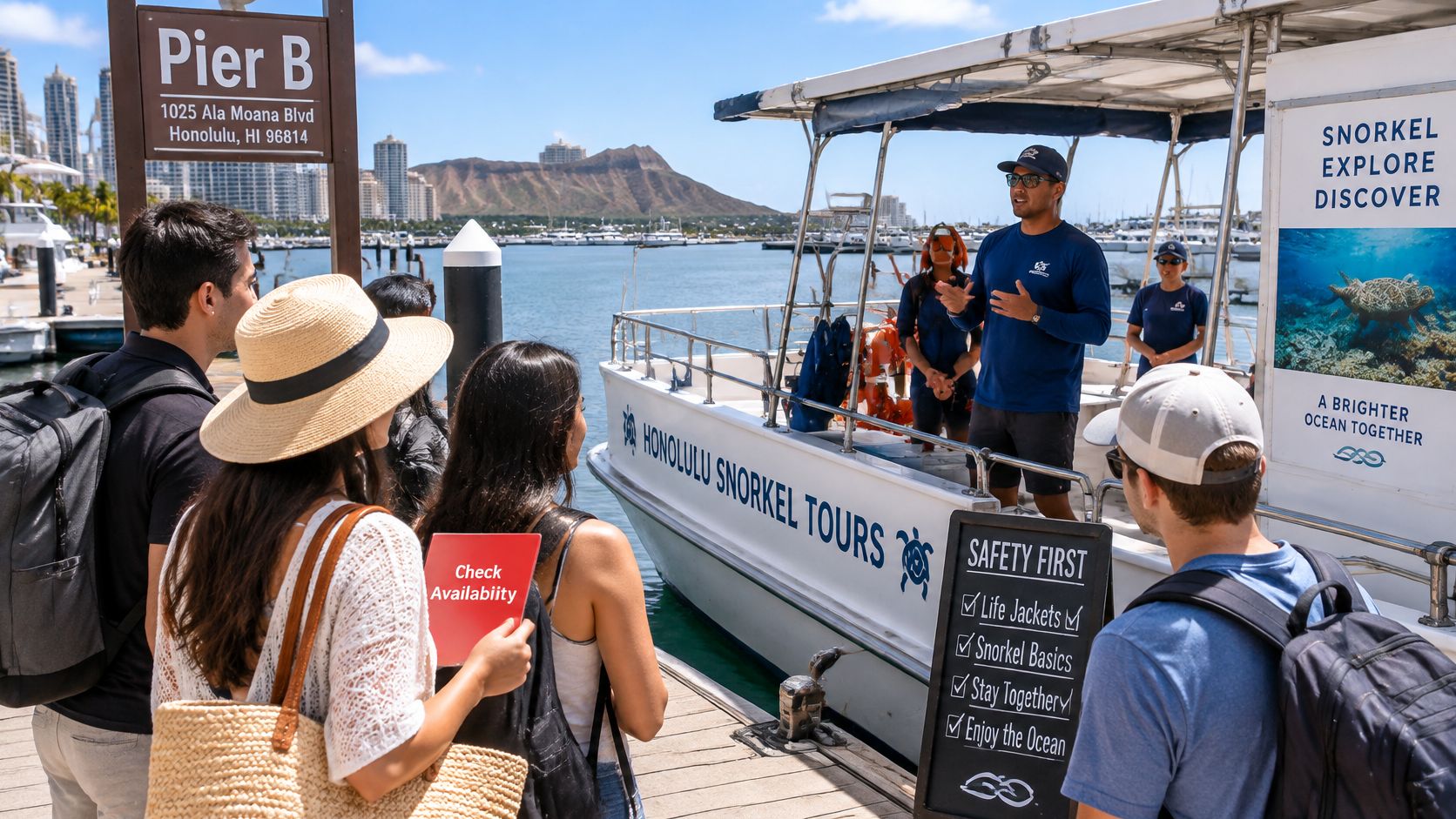
Say your group arrives at the pier wearing swimsuits under light clothing, carrying towels and sunscreen. Boarding happens at Pier B, 1025 Ala Moana Blvd, Honolulu, HI 96814, a short trip from many Waikiki hotels. From check-in to return, the whole outing runs 2 hours, and it follows the same sequence every time.
The Trip in Order
- Check in and board: You meet the crew at Pier B, settle your bag, and board with your group.
- Cruise past Waikiki: The boat runs past the Waikiki skyline and the south shore, giving you time to settle and watch the coastline.
- Get briefed and fitted: The crew gives the safety briefing and marine-life orientation, then fits you with a mask, snorkel, fins, and flotation vest. This is the moment to tell them you're nervous, prone to seasickness, or unsure about anything.
- Ride out to the reef: The boat heads to Turtle Canyon and becomes your base for entry and exit.
- Snorkel with the guide: You spend about 60 minutes in the water while the guide points out green sea turtles, schools of colorful reef fish, and other marine life. You float at the surface and look down, which is why the word canyon worries people more than it should. You're not diving down.
- Return and debrief: Back on board, you dry off, ride to the pier, and talk through what you saw with the crew.
Where the Time Goes
The 60 minutes in the water is the core of the trip. Everything else is preparation and transport, and that preparation isn't filler. A mask fitted on the boat and a clear entry procedure remove most of the confusion beginners run into at a beach on their own.
If you're comparing this reef with places you have read about on the North Shore, our guide to Turtle Bay snorkeling explains how that different setting works. Turtle Canyon is a Turtle Canyon snorkel site off the south shore, reached by boat, so plan around the departure rather than a beach walk-in.
Arrive before departure so you're not fitting gear in a rush. Expect to finish the morning tired in a good way, with salt on your skin and a clear memory of what you saw.
Gear Included and What to Bring
The short answer is that the crew supplies the snorkeling equipment. You don't need to rent a mask in Waikiki or buy fins before you arrive. Your job is the personal layer: what you wear, what you dry off with, and how you protect your skin.
Gear supplied by the crew versus what guests bring
| Item | Provided by the crew | Bring yourself |
|---|---|---|
| Snorkel mask | Yes | No |
| Snorkel | Yes | No |
| Fins | Yes | No |
| Flotation vest | Yes | No |
| Swimsuit | No | Yes |
| Towel | No | Yes |
| Reef-safe sunscreen | No | Yes |
| Hat or sunglasses | No | Yes |
| Underwater camera | No | Ask us before the trip, then bring your own with a wrist strap |
We recommend bringing a swimsuit, towel, reef-safe sunscreen, and sun protection such as a hat or sunglasses. Wear the swimsuit under light clothing so you're ready at boarding instead of changing in a cramped space. The towel is for the ride back, when the breeze feels cooler than you expect.
Why Reef-Safe Sunscreen Matters
The reef is living habitat, not scenery, and what you put on your skin ends up in the water around coral and fish. That's why the crew covers reef etiquette in the briefing, including sunscreen and not standing on coral. Apply sunscreen before you board so it has time to absorb, and use a hat and sunglasses on deck between swims.
Practical rule: If an item would upset you if it went overboard, leave it at the hotel or keep it in a secure zipped bag on deck.
Leave valuables at your hotel where you can. Jewelery, loose phones, and bulky bags create problems on a wet boat and don't improve the hour in the water. If you want photos, secure any camera with a strap and ask us in advance what's appropriate to bring, since camera availability on board isn't something to assume.
What matters most isn't extra accessories. It's gear fit. A mask that seals without leaking, fins that stay snug, and a vest adjusted before entry make your 60 minutes far more comfortable than any extra gadget. Tell the crew if your mask fogs or pinches during fitting, because that's the easiest moment to swap it.
Who Should Join and How Beginners Are Supported
Guests ages 3 and up can join, and beginners receive flotation gear and in-water support during the roughly 60 minutes spent snorkeling at the reef. Turtle Canyon's calm, turquoise water suits first-time snorkelers and experienced ones of all ages. The useful question is personal: can you stay relaxed once the bottom is out of reach?
A flotation vest works like a handrail on stairs. It holds your weight, but you still have to stand there calmly and breathe. Guests who float passively tend to do well, while guests who fight the water tire quickly. Calm floating has a second benefit. Turtles often swim within a few feet of snorkelers, and the crew asks everyone to keep a respectful, passive distance so the animals can approach on their own terms.
Guest groups, suitability and support on the trip
| Guest group | Suitability | Support on board | Check before booking |
|---|---|---|---|
| Children ages 3 and up | Accepted | Flotation support available | Confirm the child is comfortable in water |
| First-time snorkelers | Suitable | Flotation vest and simple skill coaching | Rehearse breathing through the snorkel in shallow water if possible |
| Weak swimmers | Confirm with operator | Flotation vest | Ask whether a vest is enough for your comfort level |
| Older adults | Confirm with operator | Guide supervision | Discuss your fitness with a doctor first |
| Guests prone to seasickness | Confirm with operator | Ask the crew before boarding | Ask about remedies before boarding |
| Non-snorkelers in the group | Confirm with operator | Boat transport and crew supervision on board | Ask whether they can board without entering the water |
Four Questions to Answer Honestly
- Can you swim confidently? A vest helps you float, and basic comfort in open water still matters.
- Will you panic offshore? If deep water under you causes panic, tell the crew before entry, not after.
- Are you prone to seasickness? Make your plan before boarding, since remedies work better taken early.
- Might you need to leave early? That is fine. Signal the guide and follow the boat exit procedure rather than pushing through.
Hawaii has a concrete reason for asking these questions. The Hawaii Department of Health drowning prevention information reports that snorkeling is the activity associated with more visitor drownings than any other, and that the fatal ocean-drowning rate for nonresidents is approximately eight times the resident rate. A guided morning with a vest and an in-water crew lowers your exposure to that risk.
Honest answers matter more than enthusiasm.
For a fuller picture of what the hour in the water involves, our page on snorkeling with turtles in Hawaii covers what guests typically encounter. For your own readiness, trust the answers above. Skip or modify the trip if you are a weak swimmer unsure whether a vest is enough, if a medical condition has gone unchecked by a doctor, or if being on the water makes you uneasy. Conditions change from day to day offshore, and a calmer morning is worth waiting for.
Boat Role and Responsible Turtle Viewing
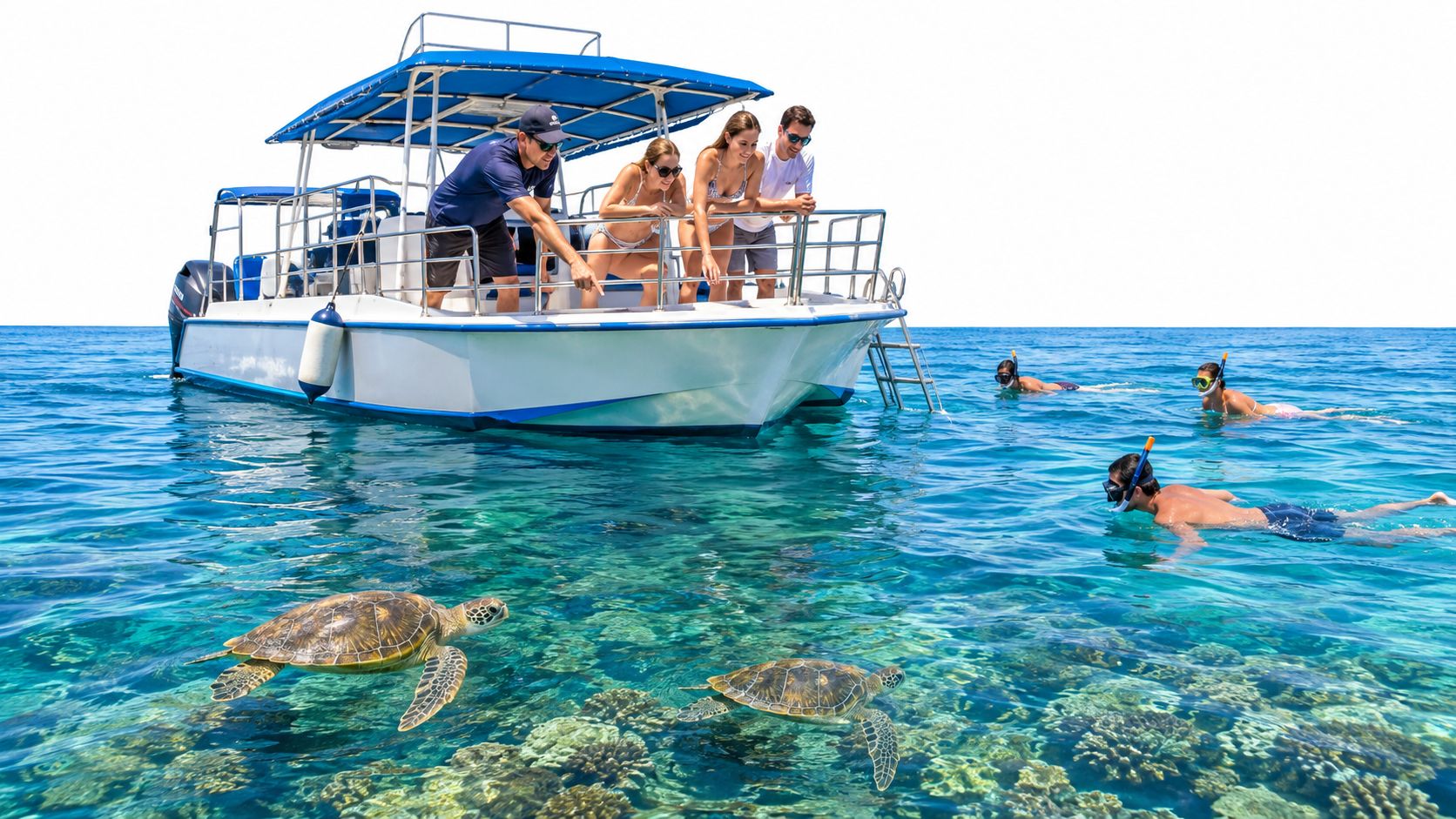
Turtle Canyon is a shallow offshore reef just off the south shore of Oahu near Waikiki, and it can't be reached safely from the beach. That's why a professional guided boat tour is required to get there. The boat gets you to deeper water, better visibility, and a higher likelihood of turtle sightings than snorkeling from Waikiki Beach, and the crew controls how the vessel moves around wildlife once you're there.
How the Boat Behaves Around Turtles
The NOAA marine life viewing guidelines for Hawaii recommend remaining at least 50 yards from sea turtles when observing from a boat, operating at no-wake speed, avoiding sudden changes in speed or direction, and placing the engine in neutral when a turtle is nearby.
In practice, the crew works through a fixed sequence:
- Slow down early: Reduce speed before entering a turtle area and keep to no-wake speed.
- Keep a clear corridor: Stay at least 50 yards away and avoid sudden direction changes that could cross a turtle's path.
- Go neutral: Put the engine in neutral when a turtle is nearby, and never trap a turtle between the boat and shore.
- Let the animal pass: Wait until the turtle clears the area before moving away slowly.
- Become a stable base: Once guests are in the water, the boat stops being a viewing vehicle. The crew watches propellers, current drift, and whether a turtle surfaces near the hull.
Distance and behavior controls for boat and in-water viewing
| Control | Boat crew | Guests in the water |
|---|---|---|
| Minimum distance from a turtle | At least 50 yards (NOAA vessel guidance) | At least 10 feet (3 m) |
| Speed near turtles | Reduce speed to no-wake before the turtle area | Slow, calm movement with no chasing |
| Engine when a turtle is nearby | Engine in neutral | Stay still and let the turtle pass |
| Direction changes | Avoid sudden changes in speed or direction | Do not swim across the turtle's path |
| Touching or feeding | Never | Never touch, feed or chase |
Your Rules in the Water
Keep at least 10 feet (3 m) from each turtle. If a turtle swims toward you, don't take that as an invitation to move closer. Stay still, let it pass, and create space when you can without splashing or surging forward. Use camera zoom instead of swimming in for a closer shot.
If a turtle changes direction, accelerates, dives repeatedly, or leaves a resting area, the group is already too close and should retreat.
Never block a turtle's route to the surface, since it needs to breathe. Never form a circle around one, and don't position yourself between a turtle and open water. Keep your fins off the coral, float horizontally, and kick slowly so you don't stir up sand or strike the reef.
If you want background on the animals themselves before your trip, our Hawaii turtle guide introduces the species you'll be watching. On the day, your guide handles positioning, so listen for instructions to hold, back up, or regroup.
One last point causes confusion. If you spot an entangled or injured turtle, tell the crew at once and don't attempt a rescue yourself. Untangling an animal can injure it further and put you at risk. Reporting it quickly is the useful action, and the crew knows what steps follow.
Calm, non-pursued turtles behave naturally for longer. You'll see more real foraging, resting, and surfacing by giving them room than by chasing a close view.
What a Turtle Sighting Really Means
A sighting record can set the wrong expectation if you read it as a promise of a close-up. Snorkel Turtle Canyon sees sea turtles on 99% of its trips, and that's a strong record.
That figure describes how often turtles are seen. It doesn't describe how close you'll get, how long a turtle will stay, or whether one will surface beside you. A high sighting rate creates a quiet pressure to crowd animals or stretch an encounter so everyone gets a photo. A responsible guide resists that pressure.
Redefining a Successful Encounter
A good encounter means you watch a turtle feeding, resting, or surfacing undisturbed. The turtle sets the terms. If it changes direction, speeds up, dives repeatedly, or leaves its resting area, the encounter has already gone on too long, and the right move is to back away and accept a shorter view. That isn't a failed trip. That's the trade-off working as it should, because your brief, calm observation left the animal's day intact.
The measure that counts: The turtle doesn't alter what it's doing because you're there.
Context makes restraint easier to accept. The NOAA green turtle species page describes a Hawaiian population that now includes roughly 4,000 breeding females, after the population approached near extinction in the early 1970s. NOAA also reports that more than 90% of the Hawaiian green turtle population nests at Lalo, also known as French Frigate Shoals, in the remote Northwestern Hawaiian Islands. Those nesting islands are not open to casual visitors, which makes Oahu's nearshore feeding and resting reefs a genuine opportunity rather than a staged attraction.
If you're weighing where else turtles are seen around the island, our guide to Turtle Beach on Oahu explains that shore-based setting. At Turtle Canyon, you're a guest in everyday habitat the turtles are still using. The sightings are real, and frequent. The best version of one is quiet, and sometimes brief.
Book Your Turtle Canyon Snorkel Tour
The Turtle Canyon Snorkel Adventure costs up to $109, lasts 2 hours, and is open to guests ages 3 and up. Snorkel Turtle Canyon offers a limited number of spots each day, so booking in advance matters, especially if you need a specific date or only have a few days on the island. The most common planning mistake is waiting until you arrive and hoping space remains on your preferred morning.
Choosing Your Departure
Pick a morning departure if anyone in your group is new to snorkeling. Conditions are commonly calmer earlier in the day, and an early trip leaves the afternoon open for lunch or the beach. Keep the rest of that day light. You'll be pleasantly tired after time in the water, and a loose schedule absorbs any delay getting back to the pier without stress.
Turtle Canyon can be visited year-round, so the decision comes down to your group's readiness and your itinerary rather than a single correct season. Build in travel time to Pier B at 1025 Ala Moana Blvd and aim to arrive before the departure time, not at it.
Your Next Steps in Order
- Confirm the date: Choose the day that fits your stay, with a preference for a morning.
- Check each guest's comfort: Talk through swimming confidence, seasickness, and comfort in open water for every person in your group, including children and older adults.
- Ask remaining questions now: Confirm whether a non-snorkeler can ride along without entering the water, and ask about cameras or anything specific to your group before the day arrives.
- Pack the personal items: Swimsuit worn under light clothing, towel, reef-safe sunscreen, and a hat or sunglasses. Leave valuables at the hotel.
- Reserve your places: Secure your spots while your preferred date is still open.
Once you've booked, the day itself runs on a simple plan. You meet at Pier B, cruise out past the Waikiki skyline on a spacious boat, and spend roughly 60 minutes in the water while the crew points out turtles, angelfish, parrotfish, and whatever else is moving over the reef that day. Gear and flotation vests are already on board, so your real jobs on the ride out are listening to the briefing and getting your mask fitted. Your part at the reef is just as simple: float calmly, keep a respectful distance, and let the crew guide the encounter so the turtles go about their day undisturbed.
Ready to see Hawaiian green sea turtles at an offshore reef you can't reach from the beach? Snorkel Turtle Canyon runs guided 2-hour boat trips from Pier B with gear, flotation vests, and in-water guidance included, so you can focus on floating calmly and watching the reef. Book your date in advance, bring your swimsuit and reef-safe sunscreen, and let the crew handle the rest.