
You're in your Waikiki hotel room, checking the forecast while someone in the family asks whether they really have to swim. You want to see turtles, but you also need to know where to meet the boat, what to pack, and whether this is a sensible outing for a nervous beginner.
A Turtle Canyon snorkel tour on Oahu is best understood as a supervised offshore visit, not a promise of a close wildlife encounter. Plan around the boat schedule, make an honest decision about water readiness, and let the crew manage the reef stop. A turtle sighting is a bonus, not something anyone should chase.
Table of Contents
- The Two-Hour Turtle Canyon Day at a Glance
- Getting from Pier B to an Offshore Reef
- Included Gear and What You Still Bring
- Morning Water and When Snorkeling Is Called Off
- Beginners Children and a Real Readiness Check
- Watching Honu from Ten Feet Away
- Check Availability for Your Waikiki Dates
The Two-Hour Turtle Canyon Day at a Glance
The outing takes about two hours, with approximately 60 minutes of supervised snorkeling. The remaining time covers boarding, the safety briefing, gear fitting, the coastal ride, and the return to the harbor. Don't read the trip length as continuous swimming time.
Check in at Pier B, 1025 Ala Moana Blvd, Honolulu, following the arrival instructions on your booking confirmation. Arriving at the harbor and finding the correct pier are separate tasks, so leave yourself room to locate the crew without rushing.
Your One-Page Departure Brief
Turtle Canyon snorkel tour at a glance
| Part of the trip | Typical time or rule | What you do |
|---|---|---|
| Meet and safety briefing | Start of the outing | Check in at Pier B, fit gear, hear turtle rules |
| Ride to the reef | Inside the 2 hours | Cruise the Waikiki coast to the offshore canyon |
| Snorkeling | About 60 minutes | Supervised swim with mask, fins, and a flotation vest |
| Return to the harbor | Rest of the 2 hours | Ride back to Pier B after the reef stop |
| Who may join | Ages 3 and up | Families and first-timers with flotation and a guide |
| Gear on the boat | Included | Sanitized mask, snorkel, fins, and flotation vest |
Treat the briefing as part of the activity, not something to talk over while sorting a camera. You need to recognize the crew's signals, understand the swimming boundary, and know how to request help or return to the boat.
During the snorkeling portion, our crew points out turtles, schools of colorful fish, and other marine life. Looking where a guide indicates is more useful than swimming farther away in search of something bigger. Stay with the group and give yourself time to notice what's happening below.
What the Schedule Does and Doesn't Promise
The planned swim is a window for supervised exploration, not a requirement to stay in until the crew calls everyone back. If you're tired, uncomfortable, or finished, tell a guide and follow their directions for returning aboard.
Our operating history includes Hawaiian green sea turtle sightings on 99% of trips. That's a record of past encounters, not a guarantee for your departure. Wild turtles choose where they feed, rest, and travel.
Trip mindset: Book a guided reef visit that you'd still value without a turtle photograph.
A useful family conversation happens before leaving the hotel: who wants to snorkel, who feels uncertain, and who would rather watch from the deck? Don't make entering the water a test of courage. Guests have a better chance of enjoying the outing when they can state their limits without disappointing the rest of the group.
Keep the rest of the day realistic, too. You'll need time outside the excursion for your transfer, finding the departure point, and getting settled afterward. The boat trip is compact, but your hotel-to-hotel outing takes more planning than the advertised duration alone suggests.
Getting from Pier B to an Offshore Reef
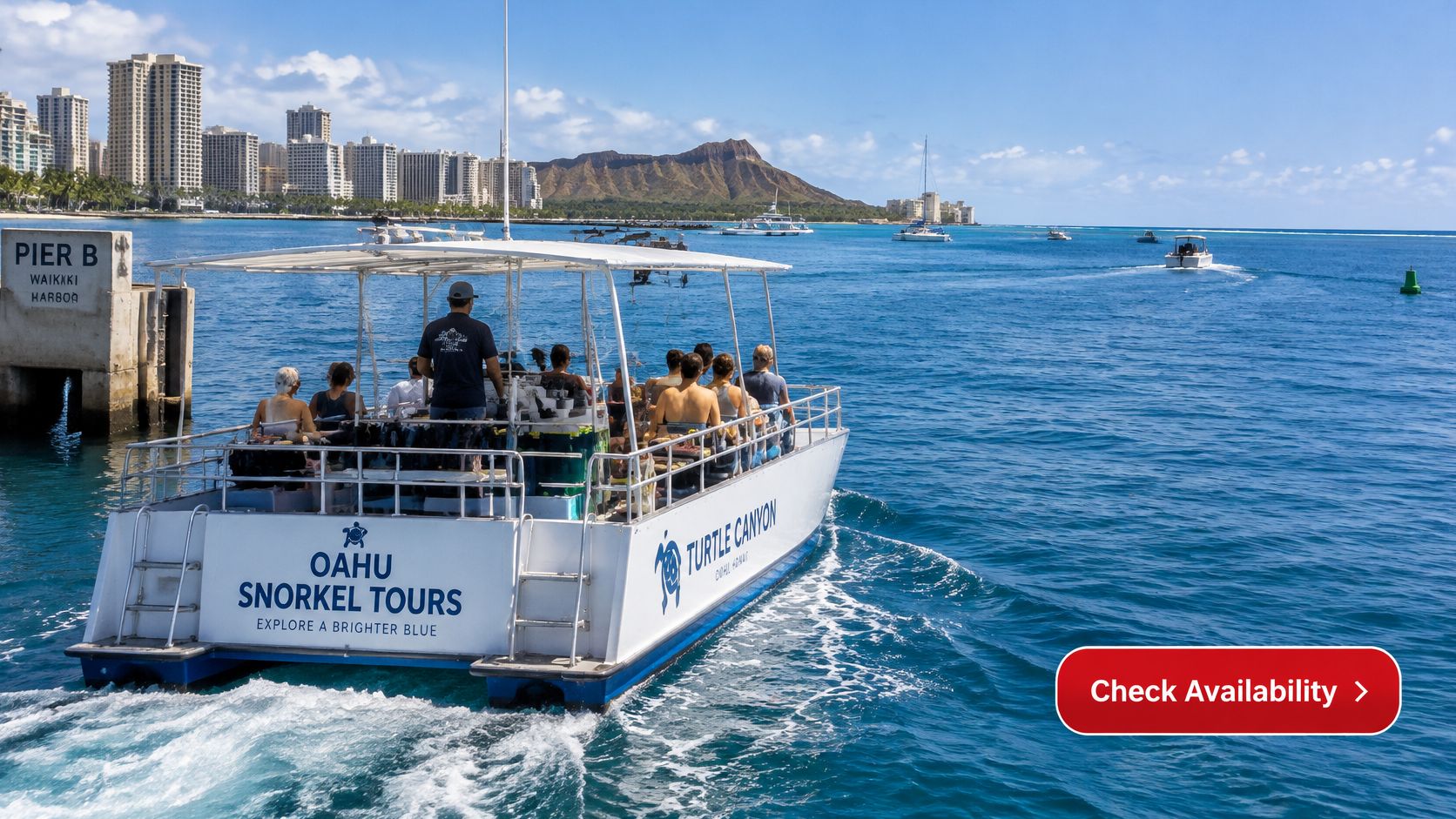
Turtle Canyon is a shallow offshore reef off Oahu's south shore near Waikiki. The word canyon can be misleading: you aren't visiting a land formation or walking down to a beach entrance. The attraction is underwater, beyond the shoreline.
Our office is at 1025 Ala Moana Blvd, Pier B, Honolulu, HI 96814, and departures are convenient for visitors staying at Waikiki hotels and resorts. Check your confirmation for meeting instructions rather than assuming any boat at the harbor is yours.
Why You Go by Boat
A professional guided boat tour is necessary to reach this reef safely. Don't try to turn it into a swim from Waikiki Beach. Boat traffic, changing surf, and open-water exposure make that a different undertaking from snorkeling within a designated beach swimming area.
The ride also gives you a useful view of the setting. You leave the harbor, see Waikiki's coastline from the water, and reach an offshore habitat rather than entering through the breaking waves at the beach.
Compared with snorkeling from Waikiki Beach, Turtle Canyon offers deeper water, better visibility, and a higher likelihood of turtle sightings. Those advantages don't mean every departure has clear water or that offshore conditions are automatically suitable for every guest.
- Beach access: You manage the shore entry and stay within appropriate swimming areas.
- Offshore access: The captain handles navigation while the crew directs entry, swimming boundaries, and the return aboard.
- Reef observation: Guests look down into habitat rather than standing or walking across it.
Why Turtles Aren't Everywhere
NOAA-supported Pacific coral-reef surveys found the Hawaiian Islands had the lowest average turtle density among the surveyed regions, at about 0.07 turtles per kilometer, while also showing the study's highest annual population growth rate, according to NOAA Fisheries. That regional finding isn't a prediction of what you'll see at this particular reef.
Turtles use suitable feeding and resting habitats unevenly. A crew's understanding of the reef helps direct observation, but it doesn't give anyone control over the animals.
If you're comparing place names while planning, our guide to Turtle Island in Honolulu can help you sort out the terminology. For this outing, keep the practical distinction clear: the boat is your transportation, and the offshore reef is your destination.
Included Gear and What You Still Bring
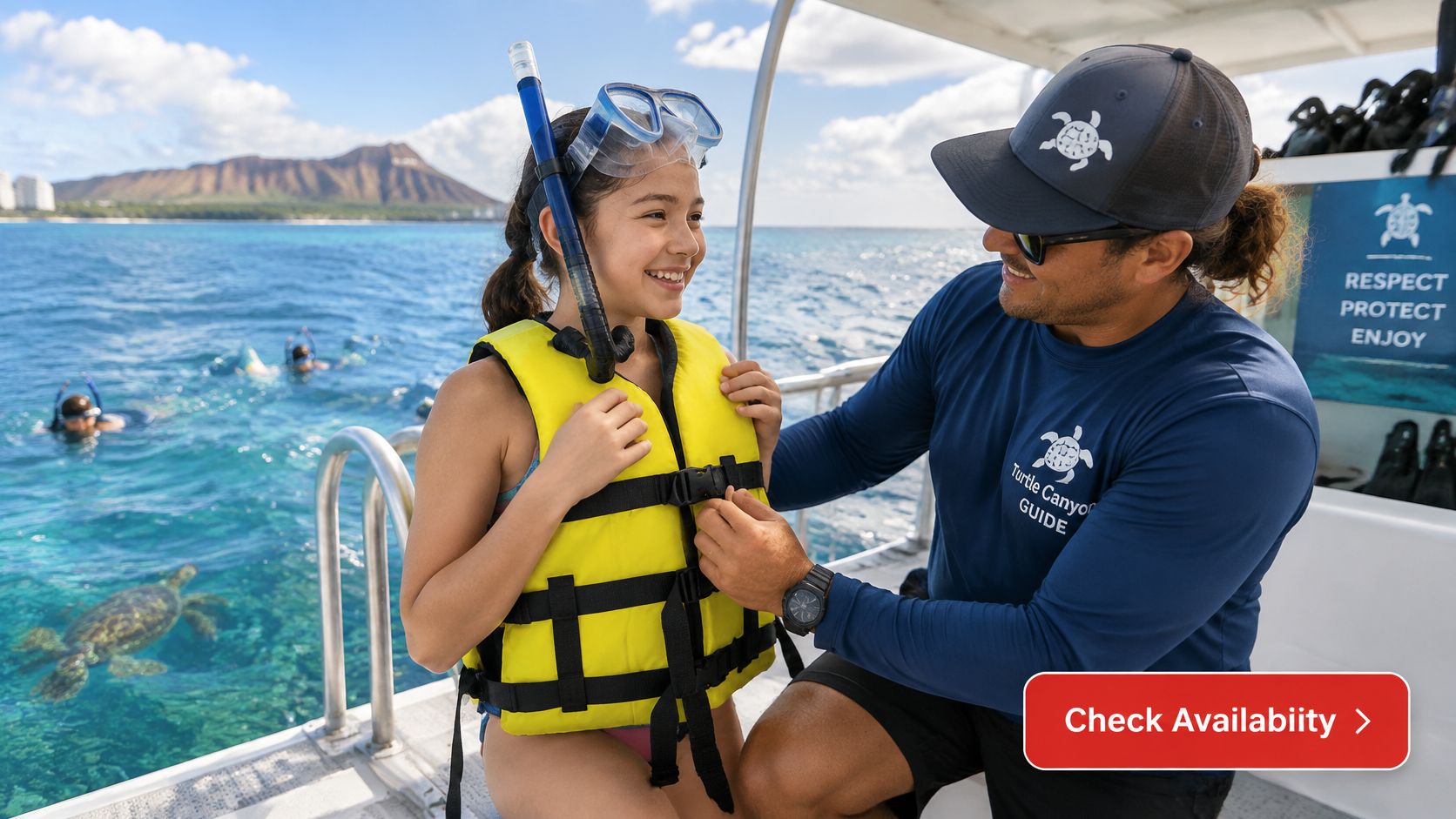
You don't need a rental-shop stop before boarding. Premium, sanitized masks, snorkels, fins, and comfortable flotation vests are already on the boat. Your preparation is mostly about fit, personal comfort, and keeping your bag manageable.
The mask should seal comfortably against your face without needing an overtightened strap. Move hair away from the seal, check that the snorkel mouthpiece feels manageable, and tell the crew about pinching fins before entry. Small irritations are easier to fix on deck than while you're trying to stay with the group.
Fit Comes Before Photography
Use the fitting period to concentrate on equipment rather than attaching camera accessories. Our crew checks fit before entry and provides in-water guidance afterward.
If you wear glasses, raise that during the briefing. Ordinary glasses usually interfere with a standard mask seal, so don't assume you can tuck the arms under the skirt and solve the problem. Discuss what you need before leaving the boat.
A flotation vest supports you at the surface while you look down and breathe through the snorkel. It isn't a substitute for understanding the equipment or feeling comfortable with your face in the water.
Keep the Personal Bag Simple
Our recommended packing list is short:
- Swimsuit: Wear it beneath a cover-up so you're ready without an awkward clothing change.
- Towel: Keep it dry for the return ride rather than spreading it where boarding guests will step.
- Reef-safe sunscreen: Apply it before boarding, following the product's directions.
- Hat or sunglasses: Bring sun protection for the deck and secure loose items before the boat gets underway.
A dry shirt can make the ride back more comfortable. You don't need spare fins or cash set aside for equipment rentals, and a bulky cooler makes a shared boat harder to move around.
Pack for a short boat outing, not a full beach setup. Keep the things you'll need after swimming together in a small bag.
For sunscreen, choose a mineral-based product and check its ingredients rather than relying only on a reef-safe label. A sun shirt also reduces how much exposed skin needs lotion. Apply sunscreen away from shared equipment and avoid leaving slippery residue on handrails.
Leave the hotel with the essentials: swimsuit, towel, reef-safe sunscreen, and a hat or sunglasses. The point is to arrive protected and ready, not to bring a second set of everything the crew already supplies.
Morning Water and When Snorkeling Is Called Off
High surf, strong winds, heavy shorebreak, and strong currents are poor snorkeling conditions identified by Hawaii's official ocean-safety guidance, which also recommends checking conditions, consulting lifeguards when available, snorkeling with a buddy, and avoiding dangerous-looking water. Its advice favors morning hours, when conditions and visibility are often better, while warning against dawn, dusk, and murky water.
Morning is a preference, not a safety certificate. A bright sky over Waikiki doesn't tell you everything about the water at an offshore reef. Wind can make the surface choppy, swell can move swimmers around, and poor visibility can make keeping the group together harder.
What the Crew Is Assessing
The decision isn't whether the boat can reach the site. Guests also need a workable entry, a manageable swim area, and a safe way back aboard. Conditions must support the least confident participating swimmer, not just the strongest person in the group.
| Condition | Why it matters to a snorkeler |
|---|---|
| Strong wind | Surface chop can make breathing and resting less comfortable |
| Strong current | Guests may struggle to remain within the designated area |
| Poor visibility | Swimmers can lose visual contact with guides and buddies |
| Significant swell | Movement near the boat can complicate entry and exit |
A crew may shorten or call off water activities when conditions aren't suitable. Accept that decision without asking a guide to make an exception because you've already put on your fins.
Year-Round Doesn't Mean Every Day
Turtle Canyon can be visited for snorkeling year-round. That describes seasonal availability, not permission to enter regardless of the day's conditions.
Say your family arrives to sunshine but the crew finds uncomfortable movement at the reef. The useful question is what the conditions safely allow, not whether the view from the hotel looked calm. A safe boat ride and a suitable snorkeling stop require different judgments.
Go-or-no-go rule: Prefer a calm morning, but let the actual water conditions decide whether you swim.
Leave flexibility around the outing rather than placing a flight or another tightly timed booking immediately afterward. Read the booking terms before paying so you understand how weather-related changes are handled; don't assume a particular refund or rescheduling policy.
Once cleared to enter, stay with your buddy and follow the crew's boundary. Permission to swim applies to the conditions the crew is managing at that moment. If those conditions change, the plan can change with them.
Beginners Children and a Real Readiness Check
More non-resident drowning deaths in Hawaii occur during snorkeling than during any other visitor activity, according to the Hawaii Department of Health, which advises that snorkelers should be experienced ocean swimmers who understand surf, currents, and breaking waves. That warning matters even when a trip includes flotation and guides.
A beginner at snorkeling isn't necessarily a beginner at swimming. Someone who swims confidently but hasn't used a mask may need equipment coaching. Someone who can't manage deep water needs a different decision, not just a tighter vest.
Use These Readiness Checks Before Booking
Comfort beyond standing depth. Can the person remain composed in water where they can't touch the bottom, including while wearing flotation? A pool's shallow end doesn't answer that question.
Recovery when equipment gets wet. Can they remove and clear a mask, replace the snorkel, and resume breathing without freezing? Practice in a controlled swimming setting before relying on that skill offshore.
Communication and listening. They need to signal a guide, recognize a stop instruction, and respond even when excited. For a child, willingness to listen matters as much as enthusiasm about turtles.
Acceptance of an early exit. Ask whether they'll leave the water if discomfort, wind, surf, or panic changes the plan. Someone determined to finish at any cost isn't making a sound readiness decision.
These checks help identify concerns; they don't certify someone as ocean-ready. Tell our crew about uncertainty before entry, including previous panic, difficulty using a snorkel, or limited swimming confidence.
The Boat Is a Valid Choice
A guest who doesn't want to swim can remain aboard and watch the reef area, including turtles surfacing if they appear. For a non-swimmer, that's the sensible option rather than using the excursion as a first deep-water lesson.
The minimum guest age is an admission rule, not evidence that a particular child should enter the ocean. A willing child who follows directions may still struggle with a wet mask, unfamiliar breathing, or the movement of the boat.
Flotation doesn't remove panic, breathing difficulty, seasickness, or the need to exit quickly. If someone begins struggling, signal the guide promptly rather than asking them to keep trying for the sake of a photograph.
Our sea turtle tour planning guide is useful for families deciding how wildlife viewing fits their group. Make that decision around the least comfortable participant, and avoid promising a child that they'll swim beside a turtle.
Guided access helps prevent guests from wandering away or crowding wildlife. It remains supervised snorkeling, not a zero-risk activity.
Watching Honu from Ten Feet Away
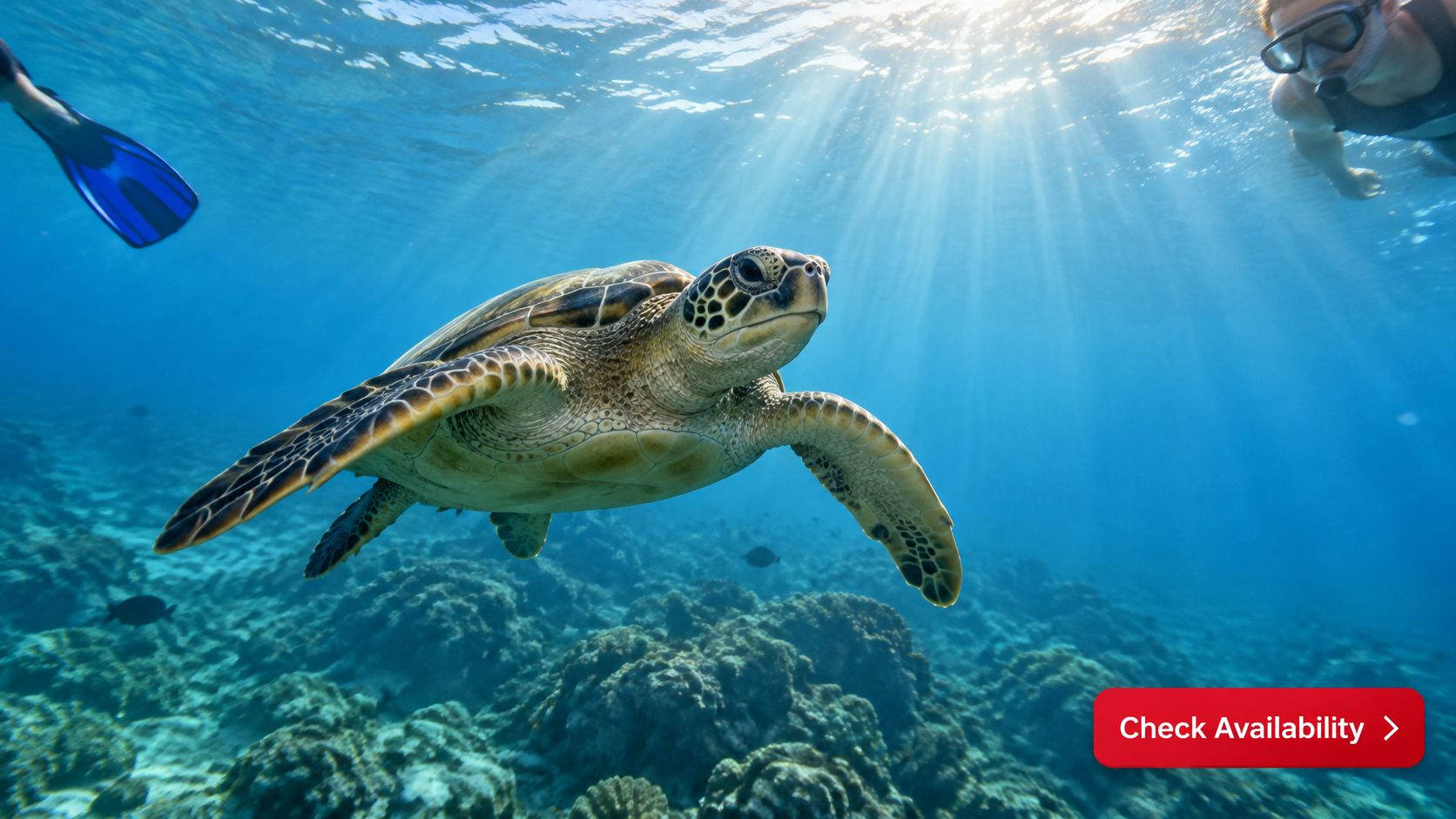
Stay at least 10 feet (3 meters) from Hawaiian green sea turtles, or honu, both in the water and on land, as recommended by NOAA Fisheries and Hawaiʻi's Division of Aquatic Resources in the Hawaii marine-wildlife viewing guidelines. This is a viewing buffer, not a target you should swim up to.
The space lets turtles rest, feed, move, and reach the surface without people blocking them. A quiet swimmer can still cause disturbance by occupying the wrong place.
Follow the Encounter Rather Than Directing It
- Move slowly. Observe from the side without swimming straight at the animal or closing the buffer.
- Keep hands and food out of the interaction. Never touch, chase, feed, encircle, or trap a turtle between swimmers and the boat.
- Leave its route open. Don't position yourself above a turtle that may need to surface.
- Use camera zoom. A closer-looking image shouldn't require a closer swimmer.
- Keep the encounter brief. Watch calmly, then let the animal continue without a trailing group.
- Disengage when it avoids you. Stop following if it turns away, dives away, or repeatedly changes direction.
NOAA's Pacific sea turtle guidance recommends limiting observation to a few minutes. A long pursuit isn't better wildlife viewing.
Turtles often swim within a few feet of snorkelers, while our crew guides guests to give them space and allow natural interactions. If one comes toward you, don't reach out or kick after it. Follow the guide's direction and calmly allow room for it to pass.
Give the Whole Group Room
The buffer applies to everyone, not just the person holding a camera. A loose semicircle of swimmers can close a turtle's route even when nobody thinks they're particularly close. Let the guide redirect the group rather than independently choosing a better angle.
Hunting Hawaiian green turtles was prohibited in 1978 after severe population depletion, according to Hawaiʻi's Division of Aquatic Resources. More recently, Oahu recorded 83 documented Hawaiian green sea turtle nests in 2024, according to Living Ocean Tours, citing Oahu nesting data.
Those are reasons to protect normal behavior, not reasons to expect animals to tolerate crowds. Our Hawaiian turtle guide offers more context for understanding honu. In the water, the task stays simple: observe without turning a resting or traveling turtle into the center of a chase.
Check Availability for Your Waikiki Dates
A Tripadvisor Turtle Canyon tour listing showed a starting price of $85 per adult in 2025. That's a dated listing, not a current quote; the Turtle Canyon Snorkel Adventure costs up to $109, and the booking calendar is where you confirm the amount for your date.
Daily spots are limited. If a particular morning matters, reserve before arriving on Oahu rather than assuming your whole group will find space at the last minute.
Check the Details Before Paying
There's no separate fee to access Turtle Canyon itself. The tour price covers the boat, crew, equipment, and guided experience, rather than admission to a wildlife attraction.
Before holding seats, confirm:
- Departure details: Match the Pier B meeting instructions to your transport plan.
- Water participation: Decide who intends to snorkel and who will stay aboard.
- Booking terms: Read the cancellation and weather-change provisions.
- Schedule space: Leave room for harbor logistics and an unhurried return.
Read guest feedback for Snorkel Turtle Canyon with those practical questions in mind.
For the rest of your day, our Honolulu activity planning guide can help you choose something that fits your group's energy after the boat ride. Keep the reservation decision straightforward: choose a suitable departure, be honest about swimming readiness, and book for the experience the crew can responsibly provide.
Snorkel Turtle Canyon offers guided boat access to the offshore reef, sanitized snorkeling equipment, flotation vests, and in-water support for a two-hour Waikiki outing. Visit Snorkel Turtle Canyon to plan your date, check departure details, and choose a reef visit that fits your family's comfort in open water.