
You're at your Waikiki hotel, looking at a turtle snorkeling booking and wondering what those two hours really include. Will you spend most of the trip swimming? Do you need your own fins? And if your child is comfortable in a pool, does that mean they'll be comfortable offshore?
A Turtle Canyon snorkel on Oahu is easier to prepare for when you separate what you can control from what you can't. You can arrive ready, check your swimming comfort, and learn how to observe wildlife respectfully. The crew handles the boat and group guidance, while the sea and the turtles determine how the encounter unfolds.
Table of Contents
- What a Turtle Canyon Snorkel Tour Looks Like Minute by Minute
- Where to Meet the Boat at Pier B
- Gear Provided on Board and What to Bring
- What You Will See in the 60 Minutes in the Water
- Staying Three Meters Away
- Safety Checks Before You Board
- Book Your Turtle Canyon Snorkel Tour Before Your Trip
What a Turtle Canyon Snorkel Tour Looks Like Minute by Minute
The outing works like a two-hour loop: board, cruise along the coast, snorkel for about 60 minutes, then ride back with time to dry off on deck. The water portion is the center of the trip, and the parts around it explain why the day feels organized rather than rushed.
Tour timeline from boarding to return
| Stage | Approximate time | What happens |
|---|---|---|
| Boarding and safety briefing | Completed before water entry | Crew check fit of gear and explain in-water rules before entry |
| Scenic cruise to Turtle Canyon | Varies with sea conditions | Waikiki skyline and south shore views while the boat runs offshore |
| Snorkeling at the reef | About 60 minutes | Guided time with green sea turtles, reef fish and invertebrates |
| Return cruise and deck time | Remainder of the 2 hours | Dry off and relax on the ride back to the harbor |
Roughly half the trip is allocated to the water. The boat portions are not filler: Turtle Canyon is offshore and is not a safe swim from the beach, so the boat provides access to the reef, a place for instruction, and a comfortable route back after swimming.
Conditions decide the fine edges of the schedule. Boarding pace and cruise length can shift with the sea, so read the table as the order of the trip rather than a stopwatch schedule, and avoid arranging another activity immediately after the expected return.
Before you enter the water
On board, the crew fits guests with masks, snorkels, fins, and flotation vests. Speak up if a mask presses painfully, a fin slips at the heel, or a vest feels awkward. A small adjustment on deck is easier than trying to solve the problem while floating.
The safety briefing explains entry and exit, guide signals, and how to stay with the group. It also gives you a chance to understand snorkel breathing before you are looking through a mask at moving water.
Say you have never used a snorkel before. Tell the crew during fitting rather than waiting until you are offshore, so they can explain mouthpiece placement and what to do if water enters the tube. That one conversation puts a worry you control on the deck, where it can be solved early.
From coastline to reef and back
The outward cruise gives you views of Waikiki's skyline and Oahu's south shore from offshore. Once the crew prepares the group for entry, follow their directions rather than jumping in independently. Their job is to time the entry to the boat position and the water conditions; your job is to be fitted, listening, and ready.
During snorkeling, stay with the guided group instead of heading toward a distant splash. Turtles often move calmly through the reef, and the crew will help guests give them space while allowing natural interactions. At the end, follow the crew's return instructions, climb aboard as directed, and use the deck time to towel off before the harbor.
Timing takeaway: Plan for the full two hours, with enough time beforehand to complete check-in before departure.
Where to Meet the Boat at Pier B
Meet the boat at Pier B, 1025 Ala Moana Blvd, Honolulu, HI 96814. This is also Snorkel Turtle Canyon's office location, conveniently situated in the Waikiki area for guests staying at local hotels and resorts. Turtle Canyon itself is a shallow offshore reef near Waikiki on Oahu's south shore, so the trip begins at the boat dock rather than with a beach entry.
Enter the full address into Google Maps or Apple Maps on the day of departure. Don't assume that a Waikiki-area departure means the dock is directly outside your hotel. Traffic, harbor entrances, and walking routes can make a journey less straightforward than it looks on a small map.
If you're comparing similarly named turtle destinations, the Turtle Island Honolulu guide can help you distinguish the place you're researching from the departure point you need.
Make the harbor arrival straightforward
- Check the confirmation email: Match the booking date and departure time, then read the check-in instructions rather than relying on a calendar reminder alone.
- Set the route before leaving: Use the complete address and check whether your map app is giving walking or driving directions.
- Protect personal items: Bring a dry bag for your phone, room key, and clothing, plus a towel for after snorkeling.
- Leave valuables behind: Keep passports, unnecessary cash, and treasured jewelry at the hotel.
The crew sets the departure, so arriving late doesn't automatically mean the boat can wait. If you're delayed, contact us directly before the trip rather than assuming someone will see a message sent through another booking channel.
A confirmed address and a planned arrival time remove most of the morning's avoidable stress. Save the confirmation where you can open it without searching through your inbox at the harbor.
Gear Provided on Board and What to Bring
Equipment provided versus items to bring
| Item | Provided by the tour | Bring yourself |
|---|---|---|
| Snorkel mask | Yes, sanitized and premium | No need to rent |
| Snorkel | Yes, sanitized | No |
| Fins | Yes | No |
| Flotation vest | Yes, comfortable fit | No |
| Swimsuit | No | Yes, wear under clothing |
| Towel | No | Yes |
| Reef-safe sunscreen | No | Yes, apply before boarding |
| Hat or sunglasses | No | Yes, use a strap |
| Waterproof camera or phone case | No | Optional, check crew rules first |
You don't need to buy or rent the basic snorkeling equipment beforehand. Masks, snorkels, fins, and flotation vests are provided on board, and the gear is sanitized between guests.
Fit matters more than how tightly you fasten everything. Keep hair out of the mask seal, position the strap comfortably behind your head, and ask the crew to adjust equipment that leaks or rubs. Overtightening a mask can make it uncomfortable without fixing the seal.
Sun protection and dry comfort
Wear your swimsuit under your clothing so you don't have to organize a change immediately before boarding. Pack a towel and a dry layer separately from anything that will get wet. Even on a warm day, wind across a wet swimsuit can make the return ride feel cool.
Choose reef-safe sunscreen by reading the ingredient label, not just the front of the bottle. A mineral-based option using zinc oxide or titanium dioxide is a practical starting point; avoid oxybenzone and octinoxate. No sunscreen label makes a product harmless in every circumstance, so a rash guard or other covering also helps reduce how much you need.
Secure hats and sunglasses with a strap or cord. Boat wind can lift a loose hat quickly, and retrieving an item from the ocean isn't something you should attempt yourself.
Keep cameras optional
A waterproof camera or phone case can be useful, but check crew rules before taking it into the water. Test the case seal beforehand and use an appropriate wrist attachment. If you're still learning to breathe comfortably, leave photography until you're settled.
The sea turtle tours guide is useful when comparing the kind of outing you want, but your packing can stay simple: swimming clothes, sun protection, and dry essentials.
Packing habit: Pack the night before, apply sunscreen 15 to 20 minutes before boarding, and keep your dry layer accessible for the ride back.
Leave jewelry and anything irreplaceable at the hotel. A lighter bag also makes it easier to keep shared deck space clear.
What You Will See in the 60 Minutes in the Water
Hawaiian green sea turtles, or honu, are the animals most visitors hope to see. The reef also supports butterflyfish, angelfish, parrotfish, and various invertebrates. Rays may appear, and dolphins are a possibility depending on the day, not an expected part of every snorkeling session.
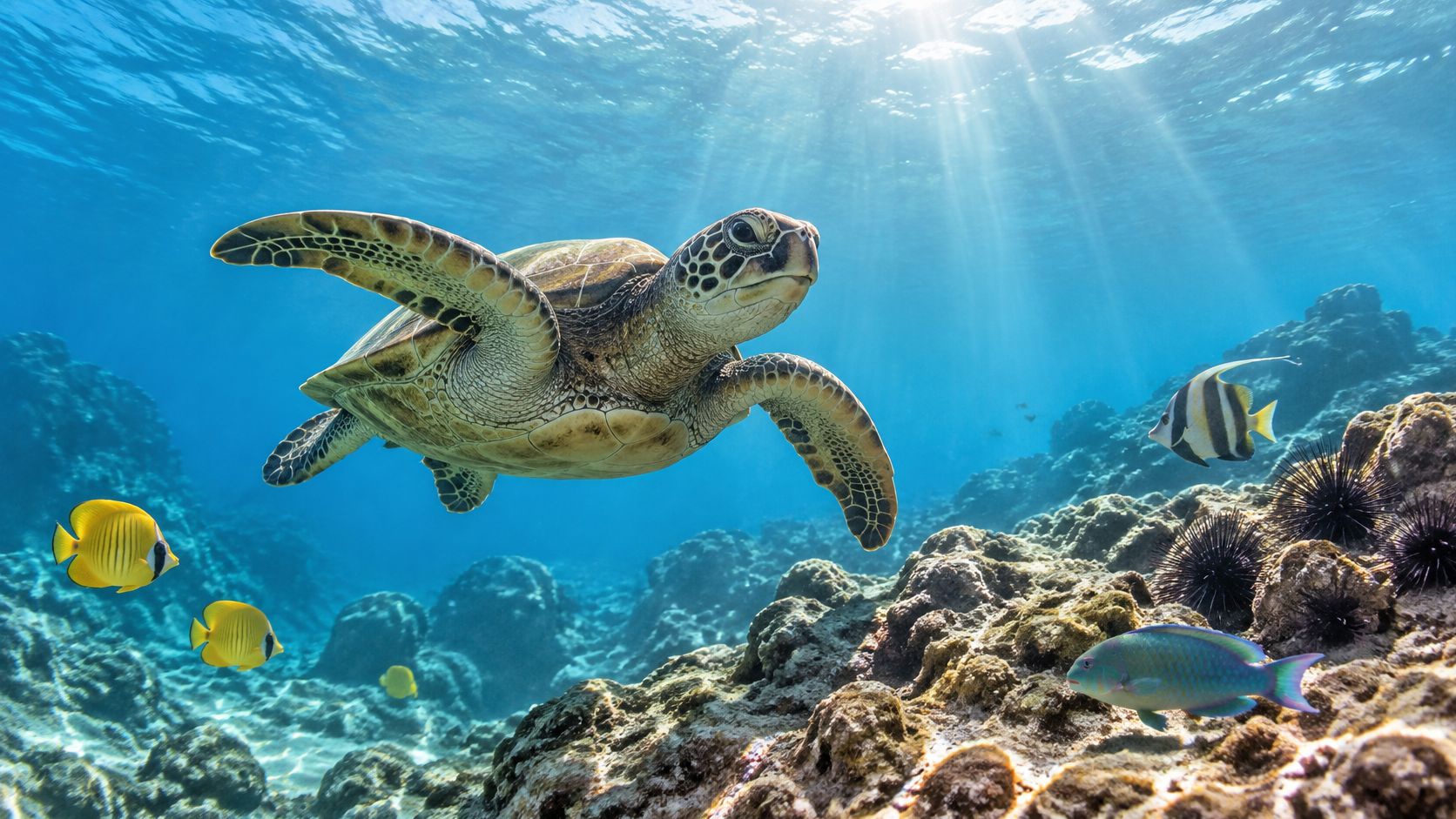
Turtle Canyon offers deeper water, better visibility, and a higher likelihood of turtle sightings than snorkeling from Waikiki Beach, although daily conditions still affect the view. During the approximately 60-minute snorkeling portion, the crew points out turtles, schools of colorful fish, and other marine life as they appear.
Green turtles use calm bays and shallow offshore reefs for resting and feeding, grazing on marine algae called limu. According to Hawaiʻi's Department of Land and Natural Resources sea-turtle guide, approximately 96% of Hawaiian green turtles nest at French Frigate Shoals, also called Lalo, in the Northwestern Hawaiian Islands; turtles encountered off Oahu may be feeding, resting, or moving through nearshore habitat.
Watch what's already nearby
A sighting is a good outcome, not a guarantee. Sea conditions affect visibility, and turtles choose where to go without regard to the tour schedule. Even without a turtle in view, reef fish and coral give you plenty to observe.
Float relaxed, breathe slowly, and look down rather than chasing movement at the edge of your vision. The reef is a habitat, and the best view comes from patience and quiet.
Staying Three Meters Away
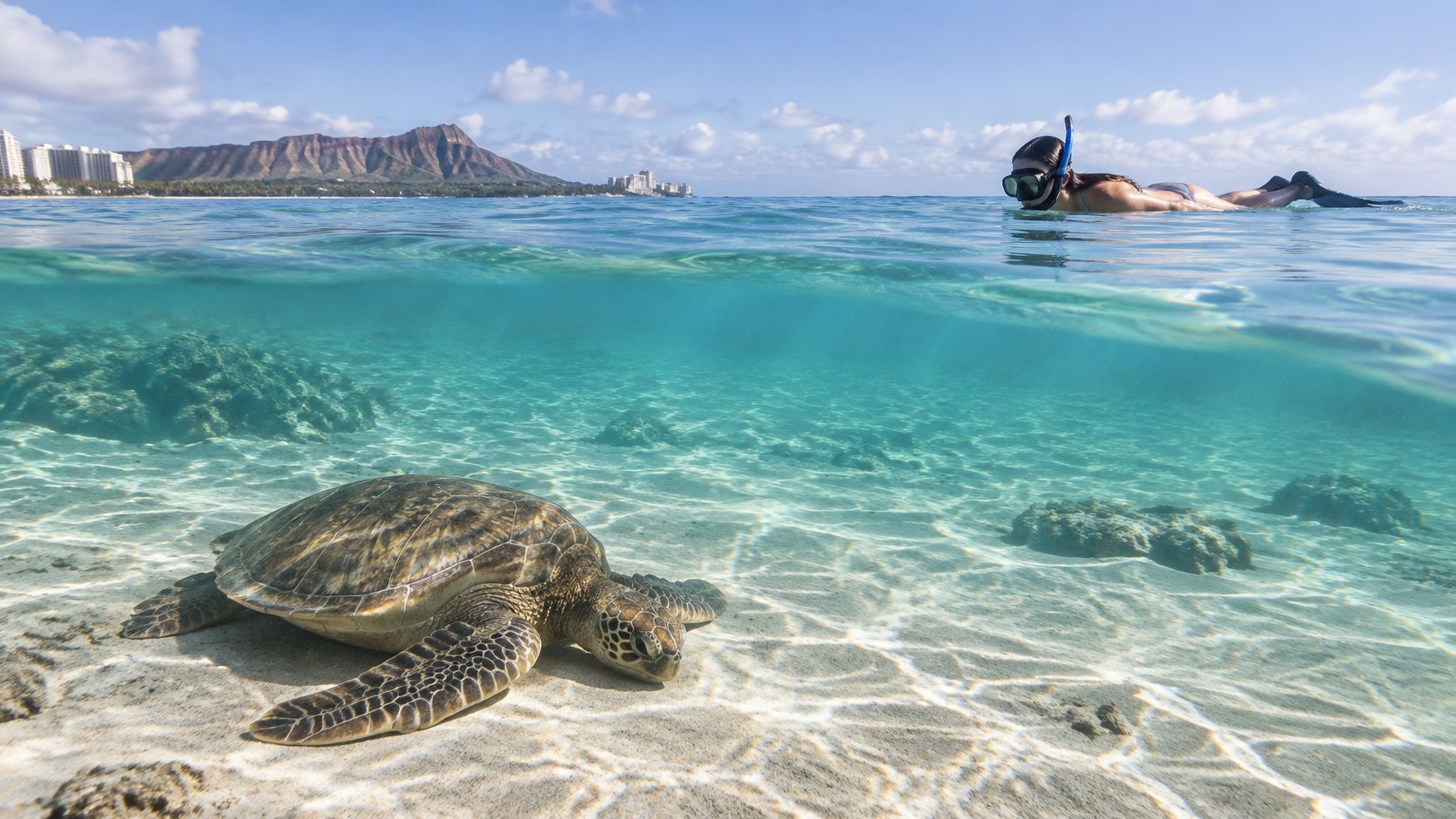
NOAA Fisheries' Hawaiʻi marine-life viewing guidelines recommend staying at least 10 feet, or 3 meters, from sea turtles, both in the water and on land.
This is the viewing standard recommended by federal and state authorities, not merely an invitation to get as close as feels polite. The distance is guidance, while disturbing protected turtles can violate federal or state law. Touching, feeding, pursuing, restraining, or riding them isn't acceptable wildlife viewing.
Give the animal room to continue naturally
- Maintain the recommended separation. When a turtle appears, stop closing the gap and check where the other swimmers are positioned.
- Never touch, chase, feed, or try to ride a turtle. Observation shouldn't change how a wild animal feeds or travels.
- Leave its route open. Don't surround it or block access to the surface, where it needs to breathe, or to the reef.
- Keep fins clear of the bottom. Avoid standing on coral or lava rock; contact can damage habitat and destabilize you.
- Float calmly rather than approaching. Let turtles choose their route, and gently create space if one heads toward you.
- Let a departing turtle go. Following it turns a quiet encounter into pursuit.
- Follow guide signals. Return to the group when called so the crew can manage spacing and supervision.
Turtles often swim within a few feet of snorkelers. That isn't permission to reach out, and you don't need to panic or kick abruptly when one passes nearby. The crew guides guests to give space and allow natural interactions; move aside gently when directed.
Cameras and excited children need attention
A beginner can drift closer while trying to correct body position. A parent concentrating on a child, or a photographer watching a screen, may also miss the shrinking gap between swimmer and turtle.
Keep checking your surroundings, not just the animal ahead. Our Hawaiian turtle guide offers more context for understanding these animals without treating proximity as the goal.
The practical test is simple: if the turtle changes its swimming because of you, you're too close. Create more space even if you believe you've maintained the recommended distance.
Safety Checks Before You Board
Calm water at Waikiki Beach doesn't mean calm water at Turtle Canyon. The reef sits offshore, where wind, swell and currents can differ from what you see beside your hotel, and it cannot be safely reached from shore. That gap between beach conditions and reef conditions is why the trip requires a professional guided boat tour rather than an independent swim.
This is also the part of the outing where your own judgment matters most. The boat, the crew and the sea are outside your control; an honest assessment of each swimmer's ability is not. A flotation vest supports a capable beginner, but it doesn't make a non-swimmer independently safe offshore and is no substitute for swimming ability.
Answer honestly for every guest
- Face-in-water comfort: Can you put your face in the water and breathe through a snorkel without immediately panicking?
- Signal awareness: Can you watch the guide and follow directions while floating?
- Boat access: Can you climb a boat ladder with assistance?
- A discomfort plan: Do you know how you'll alert the crew if you feel seasick, frightened, or too tired to continue?
A child's enthusiasm isn't the same as readiness. Practicing in a supervised pool can reveal discomfort with a mask or mouthpiece before the outing, though pool confidence doesn't establish offshore swimming ability. If a child can't manage the mask calmly at the pool, the boat is not the place to find out.
Conditions can change after departure
High surf, strong wind, heavy shorebreak, and currents are warning signs of poor snorkeling conditions. Clear skies alone are not a safety check, and a reserved seat guarantees a place on the boat rather than a fixed amount of time in the water.
Guides may shorten or cancel in-water time if conditions change. Families should contact us beforehand to confirm where children can remain supervised on the boat, whether a dry-ride option exists, and what rescheduling options apply. Those arrangements are not automatic.
If any capability checklist answer is no, choose another activity or confirm suitable options with us before booking.
Book Your Turtle Canyon Snorkel Tour Before Your Trip
Booking is the one stage of this trip that sits entirely in your hands. The boat handles the ride to the reef, the ocean sets the day's visibility, and the turtles decide how close they swim. What you control is whether a seat exists for the date you want. Snorkel Turtle Canyon offers a limited number of spots each day, so booking ahead matters most when you have a particular day in mind or only a short stay on Oahu.
The Turtle Canyon Snorkel Adventure costs up to $109, lasts 2 hours, and is open to guests ages 3 and up. Age eligibility isn't a substitute for swimming readiness, so make the decision for each guest individually.
Put the booking decisions in order
- Choose your date and a morning slot. Mornings are generally calmer, although the crew still assesses the day's conditions before departure.
- Run the readiness checklist for everyone. Resolve concerns about swimming comfort and boat access before paying.
- Read the confirmation carefully. Verify the departure time and the check-in point at Pier B, 1025 Ala Moana Blvd, once your reservation arrives.
- Use the equipment list to pack. A swimsuit, towel, reef-safe sunscreen, and a hat or sunglasses cover what the boat doesn't already supply, so skip buying gear you won't need.
- Prepare children for respectful viewing. Explain that turtles may swim within a few feet of them and that the rule is to give them space, before excitement takes over in the water.
If your travel dates or the forecast look uncertain, ask about the rescheduling policy before paying rather than after. And when several activities compete for the same days, the things to do in Honolulu guide helps you leave sensible room around the boat trip instead of stacking commitments back to back.
Once the date is set and everyone passes the readiness check, reserving the seat is the only step left. No reservation can promise a close turtle encounter, but it can put you on the water, prepared to observe whatever the reef offers that morning.
Book Your Snorkel TourSnorkel Turtle Canyon runs guided boat excursions to the reef off Waikiki, with snorkeling equipment, safety instruction, and in-water guidance included. Visit snorkelturtlecanyon.com to choose a departure that fits your Oahu plans and prepare for a respectful look at honu and reef fish in their natural habitat.