
You're in Waikiki, comparing turtle tours on your phone, and trying to work out what your family can comfortably handle. The photos look effortless, but you still need answers: how much swimming is involved, who helps with the gear, and what happens if a turtle comes straight toward you?
Oahu turtle snorkeling tours work best when everyone has a clear job. The crew manages access, conditions, equipment and group positioning. You manage your breathing, your fins and your willingness to follow directions, even when a great photo is tempting.
Table of Contents
- What an Oahu Turtle Snorkeling Tour Delivers
- Turtle Snorkeling Options on Oahu Compared
- Who a Guided Turtle Tour Suits Best
- Distance Rules and Respectful Turtle Viewing
- What to Do When a Turtle Swims Toward You
- Planning Your Turtle Snorkel Day
- Book Your Turtle Canyon Trip Early
What an Oahu Turtle Snorkeling Tour Delivers
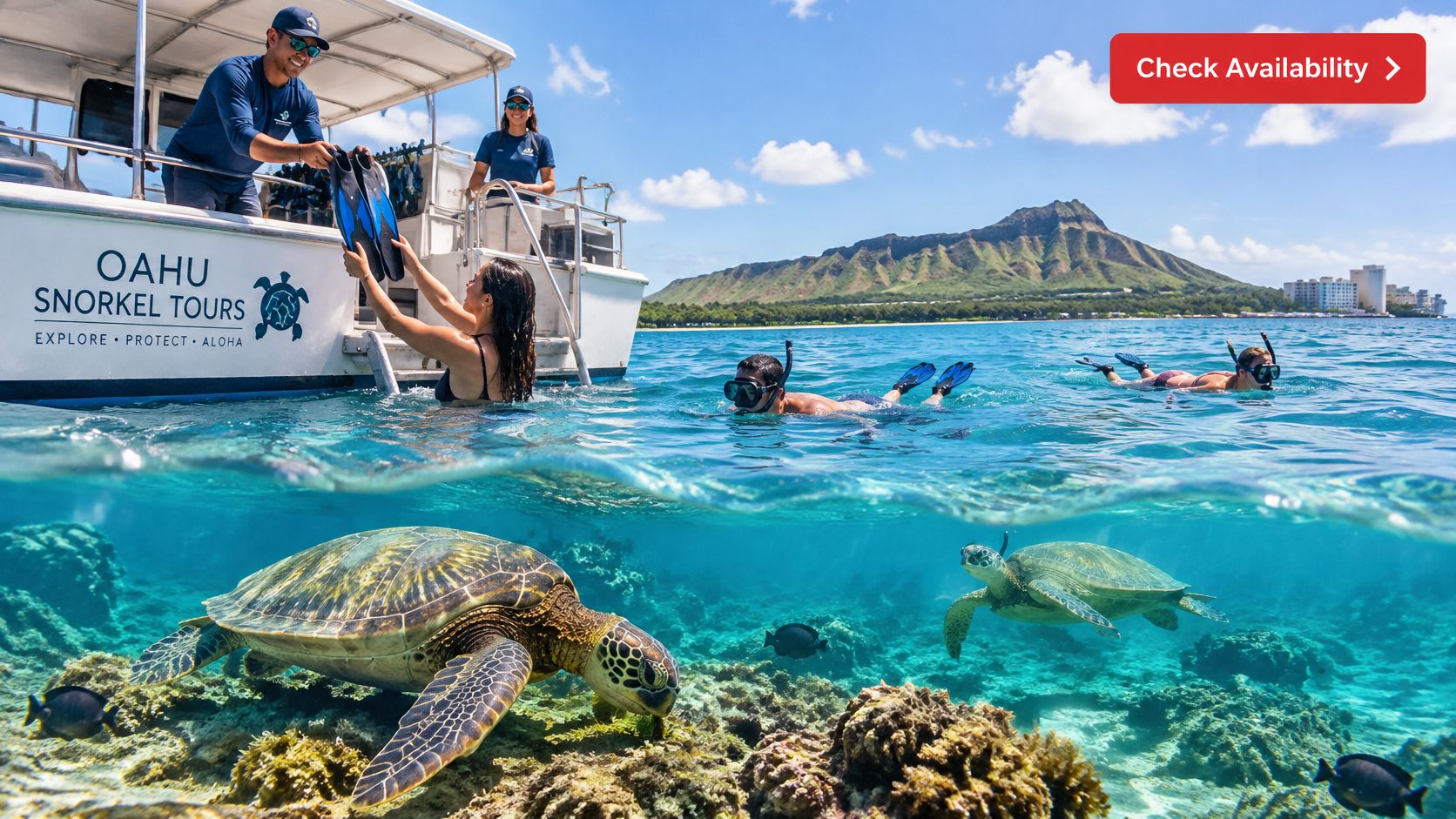
A guided Oahu turtle snorkel tour is a short boat trip to an offshore reef where Hawaiian green sea turtles, called honu, feed, rest and travel. The crew supplies snorkeling equipment and guides the group in the water. You're visiting wildlife habitat, not swimming in an enclosure with scheduled appearances.
Snorkel Turtle Canyon is a Honolulu-based operator running trips to Turtle Canyon, a shallow offshore reef just off Oahu's south shore near Waikiki. Our Turtle Canyon Snorkel Adventure lasts two hours, costs up to $109, and welcomes guests ages 3 and up. Premium sanitized masks, snorkels, fins and flotation vests are supplied on board, and a guide stays in the water with the group.
From Boarding to the Reef
A typical trip starts with boarding and getting settled, followed by a scenic cruise along Waikiki's coastline. Use that time to mention a loose mask, uncomfortable fin or concern about entering the water. Fixing equipment on deck is easier than sorting it out while floating.
Before entry, the crew explains safety, reef etiquette and how to stay with the guide. Listen for the entry procedure, the help signal and the return-to-boat signal. Those instructions matter more than memorizing fish names.
During the approximately 60-minute snorkeling portion, our crew points out turtles, schools of colorful fish and other marine life. That's dedicated reef time within the overall excursion, not a promise that every guest must remain in the water for the entire session. Afterward, there's time on deck before returning.
Wildlife Sets the Pace
Oahu recorded 83 Hawaiian green sea turtle nests in 2024, a record number, according to the U.S. Fish and Wildlife Service. That conservation milestone concerns nests on Oahu, not a count of turtles available for snorkelers to see. Nest counts and nesting-female counts are different measures and shouldn't be treated as interchangeable.
Protection and recovery are the context for the encounter. The crew's responsibility is to let you observe without disrupting the animals' day.
Seeing a turtle is the result; respectful behavior is the price of admission.
Expect an organized trip, a guide-led swim and boat access rather than swimming out from the beach. Calm conditions are desirable, but the ocean can be choppy, and turtle sightings are never guaranteed.
Turtle Snorkeling Options on Oahu Compared
| Option | Turtle encounter odds | Water access | Gear | Best fit |
|---|---|---|---|---|
| Guided Turtle Canyon boat tour | Turtle sightings on about 99% of trips, operator-reported | Boat to offshore reef, no swim from shore | Provided on board | First-timers and families |
| Waikiki Beach self-snorkel | Uncertain; day-to-day visibility affects encounters | Swim out from sand | Rent or bring your own | Confident swimmers on a budget |
| Hanauma Bay snorkel | Uncertain; season and crowds affect encounters | Walk into shallow reef from beach | Rentals on site | Beginners who want a beach day |
The important distinction is access, not whether turtles exist near shore. Hawaiian green sea turtles occur in nearshore waters and can be observed from boats, shore or while snorkeling, as described by Hawaii's Department of Land and Natural Resources, which reports that the Hawaiian nesting population reached almost 500 nesting females annually over the period it describes. That population measure covers nesting females, not Oahu's nest total or your likely sightings.
For Turtle Canyon specifically, a professional guided boat tour is necessary for safe access. The reef is offshore and can't be safely reached from the beach. Don't use a map's apparent proximity to Waikiki as a reason to attempt the swim.
What You Gain by Going Offshore
Our operating record is reflected in the table, but an operator-reported sighting rate isn't a booking guarantee. Turtles move, visibility changes and the captain must prioritize conditions over a wildlife wish list. A guide can recognize habitat and position swimmers; nobody controls when an animal appears.
Turtle Canyon offers deeper water, better visibility and a higher likelihood of turtle encounters than self-snorkeling from Waikiki Beach. The trade-off is that you board a boat, follow a group schedule and accept the captain's decisions about whether the outing can proceed safely.
Our departures are convenient for guests staying at Waikiki hotels and resorts. That reduces transfer planning, but you still need to account for travel and check-in. If you're sorting out similarly named destinations, the Turtle Island Honolulu guide helps keep location planning separate from choosing a swim.
When a Beach Option Makes Sense
Waikiki Beach self-snorkeling can be free or cheaper when you already own gear. However, you're responsible for assessing the entry, current, visibility and return route. A sandy entry doesn't mean the entire swim is easy.
Hanauma Bay suits travelers who want a beach-centered outing with shallow reef access. Turtle encounters are a possible bonus rather than something to build the day around. Admission arrangements, rental availability and beach conditions still need attention before you leave.
Decision rule: Choose a guided boat for offshore access without a shore swim. Choose a beach outing when you're confident assessing the water and happy for turtles to be a bonus.
A flexible budget helps, but flexible expectations matter more. Don't turn an unsuccessful turtle search into a longer, more tiring swim.
Who a Guided Turtle Tour Suits Best
| Traveler | Fit | What to check before booking |
|---|---|---|
| Adult first-time snorkeler | Good fit | Practice breathing through a snorkel in shallow water first |
| Family with young children | Good fit | Fitted flotation and an adult within arm's reach in the water |
| Non-swimmer or weak swimmer | Good fit with flotation | Confirm the vest fits well and stay within the guide's reach |
| Motion-sensitive traveler | Check first | Choose a morning trip and take appropriate motion medication before boarding |
| Traveler with mobility or health limits | Check first | Confirm entry, exit and any medical restrictions with the operator |
A guided trip can suit beginners because flotation and in-water guidance reduce the number of tasks they must manage alone. Premium masks, snorkels and fins help, but equipment doesn't replace comfort with breathing through a snorkel. Nor does a flotation vest make every ocean condition suitable for every guest.
The practical fit test includes swimming confidence, mask comfort, ability to float calmly, age eligibility, motion sensitivity, boarding mobility and sun tolerance during a short boat outing. Be honest about these before booking. Being comfortable in a pool isn't the same as being comfortable where you can't stand.
Prepare for the Part That Feels Unfamiliar
Practice snorkel breathing in shallow water at home or in a hotel pool where permitted, with someone supervising. Keep your face down, breathe normally through your mouth and lift your head when you need a break. Don't practice breath-holding or push through discomfort.
Tell our crew if you're nervous before entry so they can account for it when positioning the group. A weak swimmer or non-swimmer should confirm suitability before booking, remain close to the guide and be willing to stay aboard if safe participation isn't possible.
For children, check that flotation fits securely rather than riding up toward the chin. Assign an adult who stays within arm's reach in the water, and decide who supervises the child on deck. A guide watching the group isn't a replacement for a parent's attention.
Check the Boat Side of the Experience
Motion-sensitive travelers should favor a morning departure and eat lightly beforehand. If you use motion-sickness medication, ask a pharmacist or clinician which option suits you and take it before boarding according to its directions. Don't assume a medicine is suitable for a child because an adult uses it.
Call us before booking if boarding steps, a ladder exit or a health condition could limit participation. Describe the specific difficulty so you can confirm access and any restrictions rather than relying on a broad family-friendly label.
The best fit is a guest who can float calmly, communicate discomfort and follow directions without feeling pressured to continue.
Distance Rules and Respectful Turtle Viewing
| Rule | Standard | Source or note |
|---|---|---|
| Swimmer distance from a turtle | At least 10 feet (3 meters), in water and on land | DLNR and NOAA viewing guidance |
| Boat distance from a turtle | At least 50 yards | NOAA vessel guidance |
| Vessel speed near turtles | No-wake speed | NOAA vessel guidance |
| Engine when a turtle is directly ahead | Shift to neutral | State and NOAA guidance |
| Touching, feeding or chasing | Not allowed | Federal and state protections |
NOAA Fisheries' Hawaii marine-life viewing guidelines recommend observing Hawaiian green sea turtles from at least 10 feet (3 meters) in water and on land, while vessel guidance calls for at least 50 yards, no-wake operation and neutral engines when a turtle is encountered. The swimmer and boat distances apply to different actors. A swimmer's viewing buffer isn't permission for a captain to bring the vessel equally close.
Our crew explains the turtle-interaction rules before every trip: guests must not touch or chase turtles and must stay at least 10 feet away. That's an operational boundary for the group, not a target distance everyone should try to approach.
What the Crew Controls
The captain manages vessel movement. Guides manage where swimmers enter, how the group spreads out and whether someone needs redirecting. A useful briefing also makes the guide's signals clear before excitement or mask noise makes communication harder.
Guides should position people so a turtle has an open route rather than a ring of observers. They can redirect a swimmer who drifts forward, separate a bunching group and end an encounter when people can't maintain orderly spacing. The goal isn't to hold a turtle in view.
Your job is to respond promptly. If the guide motions you back, move back even if you believe you're still far enough away. The guide may be protecting a surfacing route you can't see from your position.
Distance Is Only Part of Respectful Conduct
The viewing distance is a recommended standard, not a universal minimum-distance statute. Conduct that disturbs or could disturb a turtle can still violate federal or state protections. Hawaii's state wildlife guidance distinguishes recommended separation from the broader obligation not to interfere with normal behavior.
A turtle should be able to keep feeding, resting, traveling or surfacing without accommodating the group. Touching, feeding, riding, pursuing or trapping it changes the encounter from observation to interference. Staying outside the buffer doesn't excuse blocking its path.
Turtles often swim within a few feet of snorkelers while our crew guides guests to give them space. That proximity isn't an invitation. Stay passive, make room and resist following the animal for another photograph.
The Hawaii turtle guide is a useful pre-trip resource for learning about the animal you'll be observing.
A successful encounter leaves the turtle free to carry on, not surrounded by people celebrating how close they got.
What to Do When a Turtle Swims Toward You
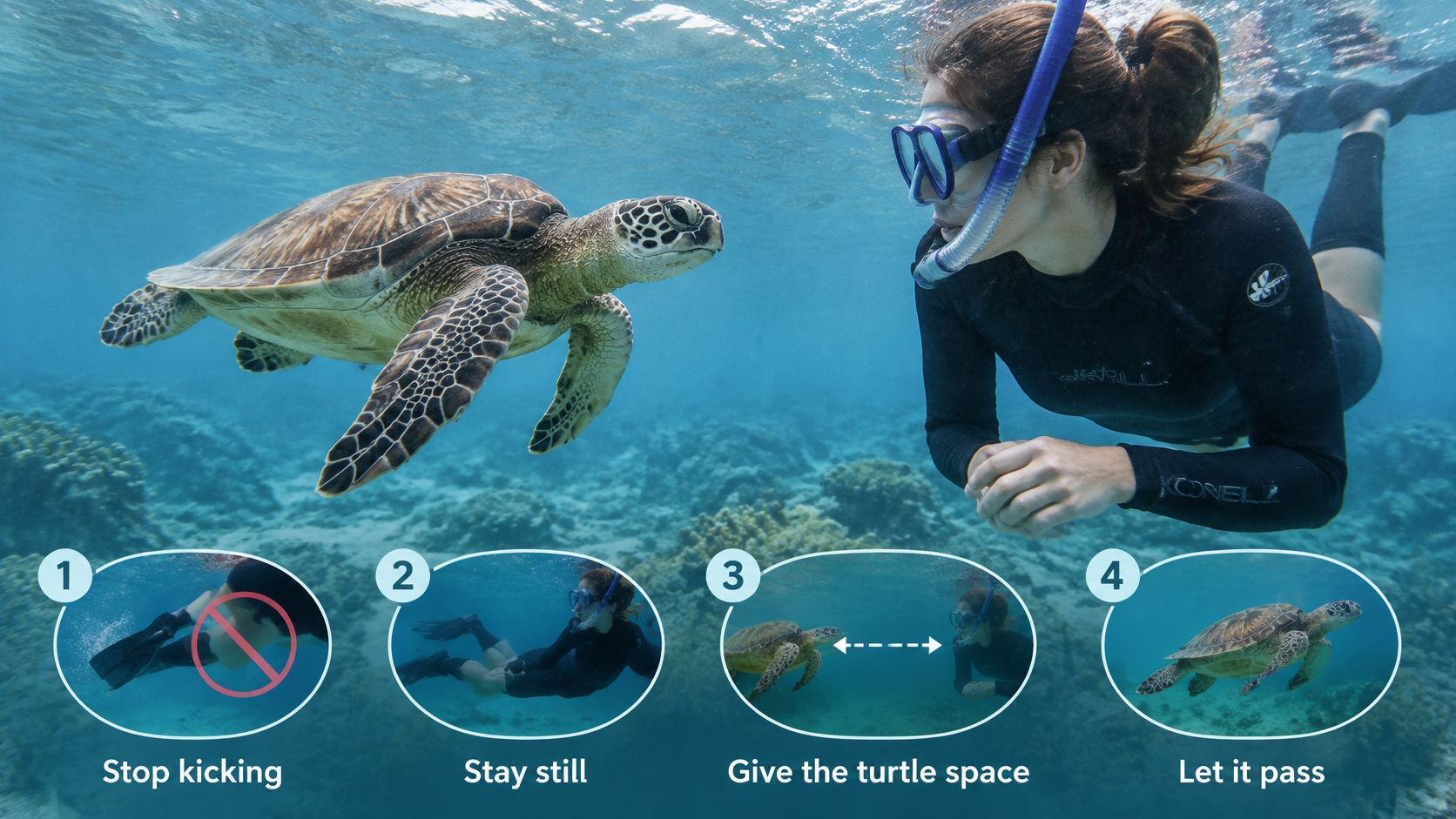
A turtle drifts toward your mask while you're watching the reef. It may be traveling through the same space, not seeking interaction. Your first task is to stop adding forward movement, then make room without splashing or colliding with another swimmer.
Make Space Without Creating a Scramble
Stop kicking forward. If the turtle is already within a few feet, stop advancing immediately. Better still, respond while it's farther away so you don't close off its options.
Float flat and settle your movement. Let the vest support you, relax your legs and avoid abrupt splashing. Brief stillness helps you assess the turtle's direction before choosing a safe way to move aside.
Keep your hands at your sides. Don't reach out, even if the animal passes close enough to touch. Keeping your hands quiet also prevents an excited gesture from becoming accidental contact.
Let the turtle choose its path. Leave room toward the reef and toward the surface. If you're in that route, move sideways rather than swimming ahead of it and making it turn.
Back away slowly and calmly if it comes within about 10 feet. Our crew's briefing uses that viewing buffer; don't wait for contact before responding. Check behind you before moving so you don't back into a child, another snorkeler or the boat.
Follow the guide's signals and remain with the group. Don't peel off after the turtle for photographs. The guide needs to keep track of guests as well as wildlife, and a departing swimmer divides that attention.
Pause when a turtle surfaces nearby. Give it room to breathe without reaching over it or moving into its upward route. A breath at the surface is part of its normal routine, not a cue to gather around.
Exit when the guide signals the end of the swim. Return by the instructed route and wait your turn at the boarding point. Don't bargain for a final photograph while the crew is organizing the exit.
These actions work together. Stillness is useful for stopping pursuit, but it isn't a reason to remain in the turtle's path. Make controlled space rather than freezing while the animal must maneuver around you.
Give Children a Clear Job
Assign a buddy to each child before entering, with the responsible adult within arm's reach. Explain the task in simple language: watch the turtle without making it change direction. That's easier to apply than a vague reminder to be careful.
If a child becomes excited, the adult should manage the child's position while listening to the guide. Don't ask the child to pose, turn toward a camera or swim closer. Keep the family together without forming a barrier across the turtle's route.
A leaking mask or a mouthful of water can distract anyone at the wrong moment. Signal the guide, regain comfortable breathing and accept help rather than trying to solve the problem while pursuing the sighting.
The best photos come from patience, not pursuit. Keep the camera close to your body, use its zoom if available and let an unobstructed turtle move through the frame.
Planning Your Turtle Snorkel Day
Pack for wet gear, sun and a boat ride, not just the underwater portion. Our office is at Pier B, 1025 Ala Moana Blvd, Honolulu. Confirm the current meeting point and required check-in time on your booking confirmation before setting out, and allow time to arrive before boarding.
Pack Light and Protect the Reef
- Wear your swimsuit: Arriving ready to get wet reduces last-minute changing.
- Bring a towel: You'll want it after leaving the water.
- Choose reef-safe sunscreen: Some sunscreen ingredients can harm corals and fish; mineral options with zinc oxide or titanium dioxide are a practical choice.
- Add a rash guard: Covering your shoulders and back reduces exposed skin and sunscreen use.
- Pack a hat or sunglasses: Protect your eyes and face while on deck.
- Skip separate gear rentals: Our crew supplies sanitized masks, snorkels, fins and flotation vests on board.
- Protect your camera: Use a waterproof case rated for immersion, not merely splash resistance.
- Bring a dry layer: Wind can feel cool after snorkeling.
- Leave unnecessary valuables and glass behind: Avoid bringing items you can't secure or keep dry.
Plan Around Conditions
- Favor morning departures: Our crew emphasizes calmer mornings, though an early start doesn't guarantee smooth water.
- Judge the day's sea state: Year-round operation doesn't mean every scheduled outing can proceed.
- Check weather terms before paying: Ask how cancellations and rebookings are handled; don't assume a refund or replacement slot.
- Keep a backup date: Leave room in your itinerary if conditions change the plan.
The Honolulu activity planning guide can help you organize the rest of the day without rushing straight from the dock to another commitment.
Screenshot checklist: swimsuit, towel, reef-safe sunscreen, sun protection, waterproof camera case, dry layer, confirmation and confirmed meeting point. Keep the packing simple enough that you can carry everything comfortably while boarding.
Book Your Turtle Canyon Trip Early
Book a specific date once your itinerary is set. Our daily capacity is limited, so advance booking makes sense when you have a preferred departure or only a short island stay. It gives you a place in the schedule, not control over weather or turtle behavior.
The Turtle Canyon Snorkel Adventure costs up to $109, lasts two hours, and is open to guests ages 3 and up. Check the booking total and select the departure that fits everyone's needs rather than choosing solely by price. A child's age eligibility, for example, doesn't answer whether they're comfortable entering offshore water.
Choose the Slot You Can Comfortably Use
Confirm swimming suitability, mobility needs and motion-sickness preparation before committing. If your group includes someone who needs additional assistance, contact us with the specific concern first. It's better to settle those questions before reserving than to discover a mismatch at boarding.
Keep location names straight, too. The Turtle Bay snorkeling guide can help you distinguish that area from Turtle Canyon off Waikiki when comparing plans.
- Pick the morning date that fits your stay, leaving a backup day if possible.
- Check the fit table for everyone in your group and resolve any participation concerns.
- Book the slot and save the confirmation with the departure address, meeting point and check-in instructions.
Snorkel Turtle Canyon offers boat access to Waikiki's offshore turtle habitat, supplied snorkeling equipment and professional in-water guidance. Visit Snorkel Turtle Canyon to plan a guided encounter where you can focus on observing honu while the crew manages access and group supervision.